

Many healthcare providers don’t want to change their Revenue Cycle Management (RCM) partner due to cost – they change due to poor financial results. The increase in claim denials, reimbursement delays, and weak communication and reporting can have a great effect on cash flow and practice expansion.
A successful RCM partner should extend your team, not merely process claims, and aid in enhancing revenue performance. If you see any of the following signs, it’s likely that it’s time to look around for another RCM provider.
What is the Role of a Revenue Cycle Management Partner?
A Revenue Cycle Management partner manages all patient care financial processes. This involves insurance verifiers, medical coders, claims submission, denial management, claim payment posting, accounts receivable (A/R) follow-up, reporting, and revenue optimization. With effective management of each stage, healthcare practices enjoy better cash flow and fewer reimbursement delays.
Learn More -: What Does a Revenue Cycle Management Company Actually Do?
12 Reasons Healthcare Providers Switch Revenue Cycle Management Partners
1. Rising Claim Denials
If there is no root cause analysis, it may be a sign of weak billing processes if the number of denials is increasing. Denials that are repeated result in loss of revenue and more administrative tasks.
Learn More -: Denial Management Playbook
2. Bad communication and lack of accountability
Healthcare organizations have their expectations of responsive communication and support. Late responses, lack of clear accountability, and general ticketing solutions can erode trust.
3. Inability to see revenue performance
With no meaningful reporting, practices don’t know what their denial rates are, what their collection performance is, what their A/R trends are, or what reimbursement opportunities might be available. The best RCM partners deliver actionable insights, rather than reports.
Learn More -: Medical Billing KPIs Every Practice Should Track Monthly
4. Accounts Receivable Continues to Grow
The longer the period between the invoice and the receipt of payment, the more the cash flow is directly impacted. More A/R days, more ageing claims and more inconsistent follow-up from the payers directly impact cash flow. The follow-up is a critical part of service that every RCM provider should be able to do.
5. Frequent Billing Errors
Claim rejections due to coding errors, eligibility problems, Modifier mistakes and under-capture of charges add to compliance risks, claim rejections and delays in reimbursements.
Learn More -: How to Build a Clean Charge Capture Process
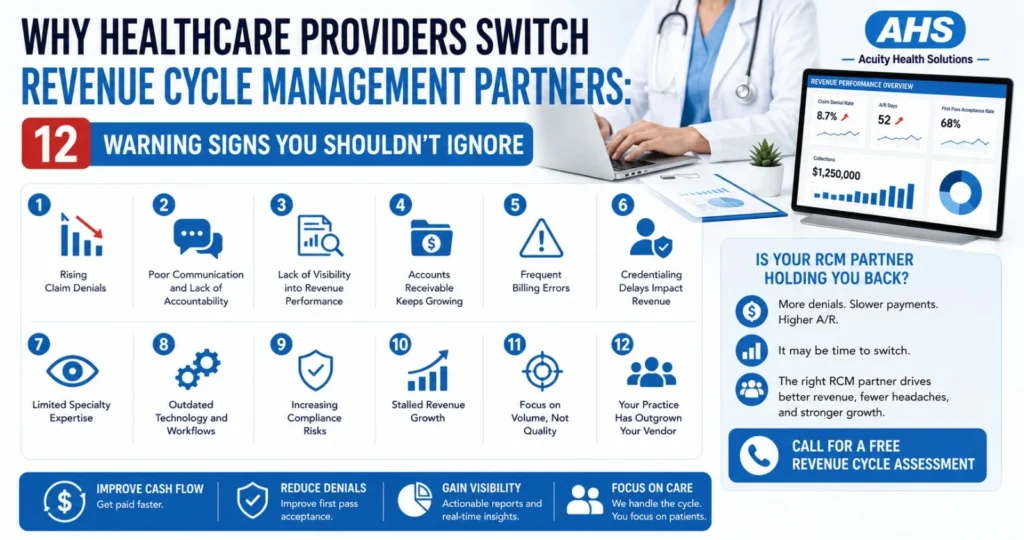
6. Delays in Credentialing Impacts Revenue
If services are provided correctly but claims are not paid due to provider enrollment delays, this is not considered a failure of the system. Provider enrollment delays that prevent claims from being paid, even when services are provided correctly, are not a failure of the system. Practices are revenue-ready thanks to strong credentialing support.
Learn More -: Credentialing & Enrollment Services
7. Limited Specialty Skills
For specialties like Ophthalmology Medical Billing, dermatology, behavioral health, and oculoplastics, there is a need for specialized knowledge of coding. Speciality-specific payers’ requirements are a hurdle for general billing vendors.
8. Outdated Technology and Workflows
Manual workflows, lack of system integration and low degree of automation can delay the billing process and cause unnecessary mistakes.
Learn More -: Technology & Automation in Healthcare Billing & RCM
Learn More -: How Automation Is Transforming Eligibility Checks & Prior Authorizations
9. Compliance Risks Increase
Lack of documentation, HIPAA compliance issues, and an ageing of coding practices can lead to audit, fines and reimbursement problems.
Learn More -: Healthcare Compliance Checklist for Medical Practices
10. Revenue Growth Has Stalled
When collections aren’t improving even as patient volumes are growing, your RCM partner may not be ensuring the optimal realization of revenue opportunities or revenue leakage is not being identified.
11. Pay Attention to Volume Rather than Quality
There are vendors who focus on simply getting claims processed, rather than preventing claims from being denied, streamlining the process, or providing ongoing revenue integrity.
Learn More -: Why Clinics Lose Revenue in Medical Billing
12. Your Practice Has Outgrown Your Vendor
If practices are moving to new sites, adding providers or new specialties, the billings become more complex. Your RCM partner should have the ability to scale with your organization.
Does Your Company’s Existing Revenue Cycle Management Partner Support You?
When claim denials are on the rise, collections are declining, there’s a lack of consistency in communication, or revenue is stagnant, it’s time to think about your current RCM partnership. The best revenue cycle management partner should help your practice to thrive in the long run, enable efficient cash flow, minimize administrative burden and give you financial visibility.