
How Acuity Health Solutions Transformed the RCM Operations of a Leading Tennessee Ophthalmology Practice, Engagement Type: RCM Audit, A/R Cleanup, Full Revenue Cycle Management Takeover, Billing Operations Optimization, Current Status: Long-term Acuity Health Solutions client with a stable, trackable, and scalable revenue cycle operation

A leading ophthalmology provider in Tennessee approached Acuity Health Solutions with a concern that his practice was not being reimbursed correctly for the services being billed.
At first, the request appeared to be a straightforward payment audit. The provider wanted to understand whether his reimbursements were accurate and whether payers were paying claims properly.
Acuity Health Solutions began with a two-year historical payment and claims analysis. What we discovered was far more significant than a simple payment mismatch.
The practice was losing approximately 30% of potential revenue due to preventable revenue cycle issues, including improper prior authorizations, coding-related denials, timely filing losses, payer follow-up gaps, incomplete operational tracking, and inefficient payment workflows.
After presenting the findings, the provider requested Acuity Health Solutions to perform an A/R cleanup. Once the cleanup produced meaningful revenue recovery and improved visibility, the provider asked Acuity Health Solutions to take over as the practice’s primary billing and RCM partner.
Over the last 4+ years, Acuity Health Solutions has transformed the practice’s RCM operation from a reactive and uncertain billing process into a structured, trackable, and predictable revenue cycle system.
Today, the provider has better visibility into revenue, fewer surprises, smoother payer workflows, stronger collections, improved financial predictability, and more time to focus on patient care and practice growth.
The Situation
The provider had built a strong Ophthalmology Practice and was seeing a consistent patient volume. However, despite billing regularly, the financial results did not feel aligned with the level of services being performed.The provider had concerns such as:
Payments did not seem consistent with billed charges
Some claims were being denied without clear follow-up visibility
Prior authorization issues were affecting reimbursement
Certain payer payments seemed lower than expected
A/R was aging without a clear resolution strategy
The practice did not have a reliable view of expected revenue
There was limited confidence in whether claims were being paid correctly
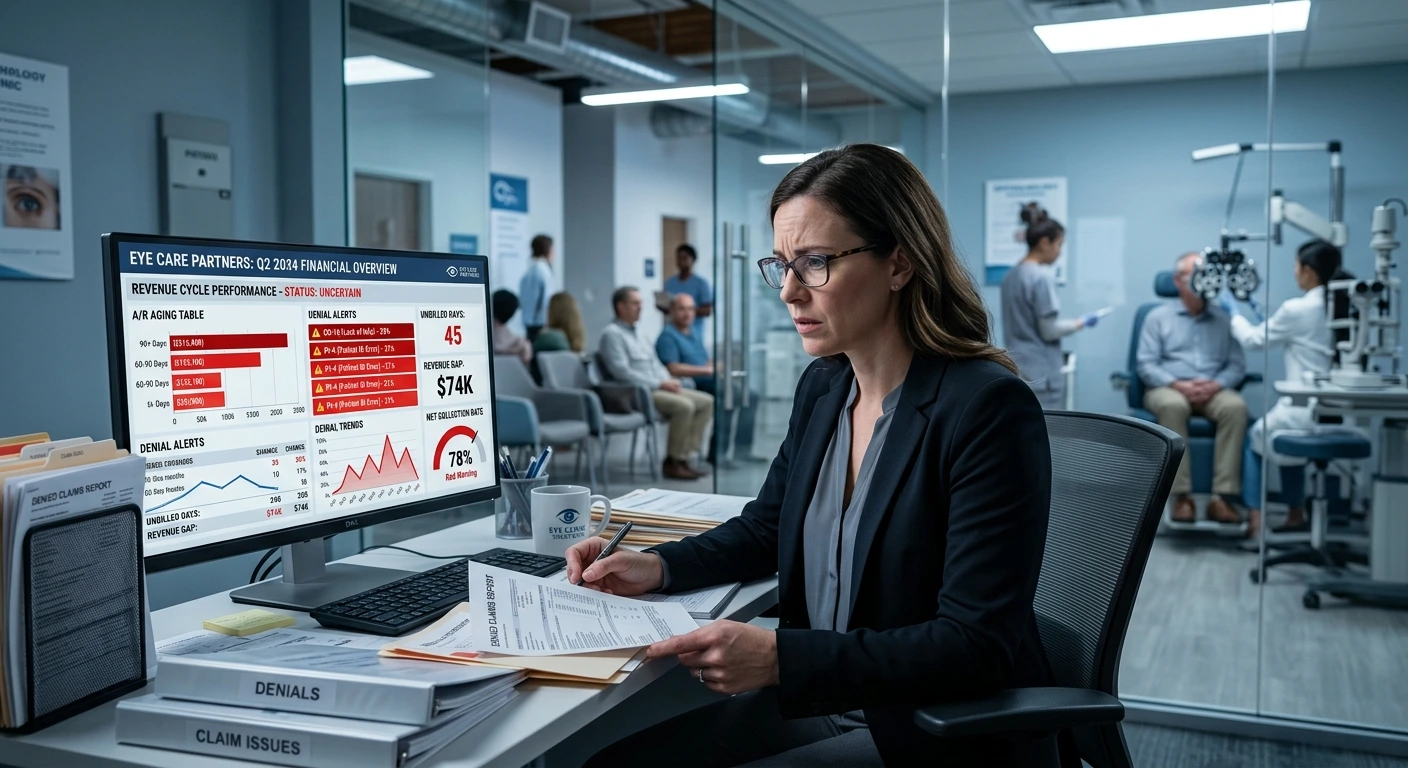
The provider needed more than basic billing support. He needed a detailed revenue cycle investigation that could identify whether revenue was being lost, where it was being lost, and how much could be recovered.
The practice was not facing one isolated billing issue. It was facing multiple revenue cycle breakdowns happening across different stages of the billing process.
The major problem was a lack of end-to-end RCM visibility.
Claims were being submitted, denials were being received, payments were being posted, and A/R existed, but the practice did not have a unified system to clearly answer these questions:
Acuity Health Solutions Initial Assessment
This was not a basic claim count or payment summary. The objective was to perform a detailed revenue leakage analysis by reviewing claim behavior, payer patterns, payment history, denial reasons, A/R movement, and operational gaps.
The audit focused on five key areas:
Acuity Health reviewed historical reimbursements to determine whether payments appeared consistent with the services billed, payer behavior, and expected reimbursement patterns. The goal was to identify: Underpaid claims Partially paid claims Inconsistent payer payments Claims paid incorrectly due to coding or modifier issues Claims denied but still potentially recoverable Missing or delayed payments
The team reviewed denial patterns to separate random payer issues from repeated operational problems. Denials were analyzed by: Payer CPT code Diagnosis combination Denial reason Authorization status Timely filing risk Corrected claim opportunity Appeal potential This helped identify which denials were preventable and which workflows needed to be corrected.
For an ophthalmology practice, prior authorization accuracy is critical. Missing, incorrect, or poorly tracked authorizations can create direct revenue loss. Acuity Health reviewed: PA-related denials Authorization requirements by payer Missing authorization records Authorization-to-claim matching issues Documentation gaps Payer-specific PA patterns This revealed that improper prior authorization handling was one of the key contributors to revenue leakage.
Acuity Health Solutions reviewed the practice’s open A/R to determine which balances were collectible, which needed urgent payer follow-up, and which were at risk due to timely filing or appeal deadlines. The team categorized A/R by: Aging bucket Payer Balance value Denial type Claim status Follow-up history Collection probability Action required This allowed the team to prioritize high-value and time-sensitive claims first.
Beyond claim-level analysis, Acuity Health Solutions reviewed the broader billing operation. This included: Payer portal access EDI setup EFT enrollment ERA availability Claim submission process Denial tracking Follow-up documentation Payment posting workflow Internal reporting Provider communication process The review showed that the practice needed stronger operational infrastructure, not just claim follow-up. Key Findings The audit revealed that the provider was losing approximately 30% of potential revenue due to avoidable and correctable RCM issues. The major causes included: Improper or missing prior authorizations Coding-related denials Timely filing denials Delayed or inconsistent A/R follow-up Insufficient payer portal access Limited tracking of denial trends Manual payment workflows Incomplete EFT and EDI setup Weak visibility into claim status Limited reporting on expected versus actual collections No structured system to track high-priority accounts The insight was clear: the practice was not just experiencing payer friction. It had revenue leakage across multiple points of the RCM lifecycle.
The audit revealed that the provider was losing approximately 30% of potential revenue due to avoidable and correctable RCM issues.
The major causes included:
The insight was clear: the practice was not just experiencing payer friction. It had revenue leakage across multiple points of the RCM lifecycle.

The Acuity Health Solution
The engagement evolved across three major phases:
Acuity Health Solutions completed a detailed retrospective review of two years of payments, denials, and outstanding balances.
The purpose was to quantify the problem, identify the root causes, and create a practical recovery roadmap.
Key activities included:
Outcome:
The provider gained a clear, data-backed understanding of why revenue was being lost and which issues needed immediate correction.
Once the revenue leakage was identified, Acuity Health Solutions performed a structured A/R cleanup.
Instead of working claims randomly, the team prioritized accounts using a recovery-driven approach.
Claims were prioritized based on:
Outcome:
The practice saw improved collections, recovered revenue from previously unresolved claims, and gained confidence in Acuity Health Solutions ability to not only identify problems but also execute on them.
After the successful A/R cleanup, the provider asked Acuity Health Solutions to become the practice’s primary billing and RCM partner.
Acuity Health Solutions took over the day-to-day revenue cycle operation and rebuilt the process around accuracy, accountability, tracking, and visibility.
The ongoing RCM scope included:
Prior Authorization Workflow Control
Prior authorization issues were one of the biggest causes of lost revenue.
Acuity Health Solutions helped stabilize this process by creating a more structured workflow for identifying PA requirements, tracking authorization status, and linking authorization details to the billing process.
Impact:
Denial Management Systemization
Before Acuity Health Solutions involvement, denials were present but not being used as a source of operational intelligence.
Acuity Health Solutions transformed denial management from a reactive task into a trackable process.
Denials were reviewed by category, payer, reason code, and corrective action.
Impact:
Timely Filing Protection
Timely filing losses represented a direct and avoidable revenue risk.
Acuity Health Solutions implemented a more disciplined A/R follow-up process to ensure claims were not aging without action.
Impact:
Coding and Claim Quality Review
Ophthalmology billing requires careful attention to CPT codes, diagnosis support, modifiers, documentation, and payer-specific rules.
Acuity Health Solutions reviewed coding-related denials and identified patterns that were affecting reimbursement.
Impact:
EFT & Payment Workflow Modernization
Acuity Health Solutions helped transition payer payments from slower manual methods, such as checks, to more efficient EFT workflows wherever possible.
Impact:
EDI & Clearinghouse Optimization
Acuity Health Solutions worked on EDI setup, payer connectivity, and clearinghouse workflows to improve claim submission and tracking.
Impact:
Payer Portal Access and Management
Acuity Health Solutions created and organized payer portal access across key payers.
This allowed the billing team to directly manage claim status, eligibility checks, authorization details, remittance information, appeals, and payer correspondence.
Impact:
Revenue Predictability and Reporting
Before Acuity Health Solutions, the provider had limited confidence in what revenue was expected, what was outstanding, and what needed action.
Acuity Health Solutions introduced clearer reporting and operational visibility.
The provider could now understand:
Impact:
Revenue became more trackable, more estimable, and more predictable.
The provider no longer had to operate with uncertainty around collections.
Dedicated Tracking Systems and Databases
One of the most valuable improvements was the creation of dedicated tracking systems to monitor billing operations.
Acuity Health Solutions built and maintained structured tracking for:
Impact:
The practice moved from uncertainty to visibility.
Instead of relying on scattered notes, emails, or payer responses, the provider had a more organized and trackable view of the revenue cycle.
The impact of Acuity Health Solutions work went beyond billing. The improved RCM operation created measurable business value for the provider and the practice.
Before and After Transformation
Practice continued to grow

This case study demonstrates that RCM is not just about submitting claims.
Strong revenue cycle management requires:
For Specialty practices like ophthalmology, small process gaps can create major revenue loss over time. A missing authorization, an unresolved denial, a delayed follow-up, or an untracked payer issue can result in thousands of dollars in lost revenue.
Acuity Health Solutions helped this provider uncover those gaps, recover revenue, and build a more reliable revenue cycle operation.
Acuity Health Solutions has now supported this provider for more than four years.
The practice has evolved from having uncertainty around reimbursement to having a structured, smooth, and trackable RCM operation.
Today:
The provider has become one of the prominent ophthalmology providers in Tennessee, supported by a stronger backend revenue cycle operation that allows the practice to focus on patient care, growth, and long-term stability.


What began as a simple reimbursement audit became a complete revenue cycle transformation.
Acuity Health Solutions identified significant revenue leakage, performed a structured A/R cleanup, recovered revenue, stabilized billing operations, and became the provider’s long-term RCM partner.
By combining detailed analysis, technical billing expertise, payer follow-up discipline, operational tracking, and continuous process improvement, Acuity Health Solutions helped the practice move from uncertainty to control.
The result was not just better collections.
The result was a more confident provider, a smoother operation, a more predictable Revenue Cycle, and a stronger foundation for practice growth.
This is the kind of impact Acuity Health Solutions delivers: detailed, disciplined, transparent, and built around long-term provider success.
A comprehensive RCM audit revealed significant revenue loss. Through A/R recovery, denial management, and full revenue cycle support, Acuity Health Solutions helped create a more predictable and scalable billing operation.