Payer Enrollment Checklist for a New Medical Practice
A complete payer enrollment checklist for new practices, from entity and provider readiness through CAQH, PECOS, contracts, effective dates, ERA/EFT, and first claims.


Healthcare compliance is no longer a once-a-year audit exercise. In 2026, medical practices face tighter CMS scrutiny, evolving HIPAA enforcement,...

Healthcare Compliance continues to evolve rapidly, and 2026 brings several important regulatory, documentation, and billing-related changes that medical practices cannot...

One of the most complicated fields of Revenue Cycle Management is infusion therapy billing. Even small coding or documentation mistakes...

The success of a practice financially in the modern healthcare setting is directly related to billing efficiency. The reimbursements are...

In 2026, deciding on the Medical Billing Firm is no longer merely a question of outsourcing administrative tasks; it directly...

Many healthcare practices think that they have a successful revenue cycle when they submit claims and get paid on a...

Operational cost escalation, staffing shortages, payor complexity and reimbursement pressures have been and will continue to put a strain on...

The term Revenue Cycle Management (RCM) is commonplace in the healthcare industry, but most people think of Medical Billing when...

Many healthcare providers don’t want to change their Revenue Cycle Management (RCM) partner due to cost – they change due...

The billing process for infusion therapy is one of the most complex in Medical Billing, featuring time-based CPT coding, drug...

A complete payer enrollment checklist for new practices, from entity and provider readiness through CAQH, PECOS, contracts, effective dates, ERA/EFT, and first claims.
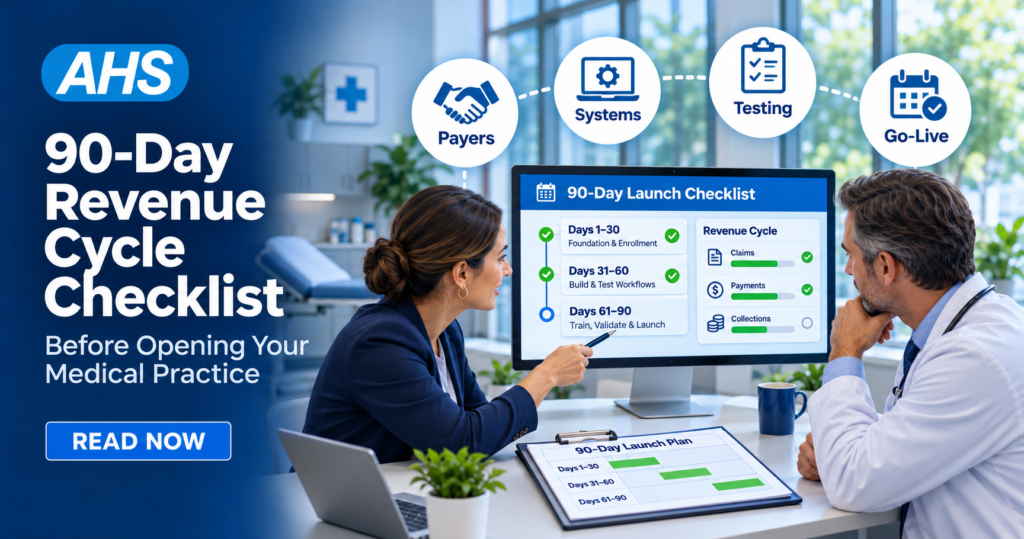
A week-by-week revenue cycle checklist for the 90 days before a medical practice opens, covering payers, systems, workflows, testing, payments, and go-live controls.

Compare medical billing software, outsourced billing, and hybrid models for a new practice across cost, staffing, control, compliance, technology, and cash-flow risk.