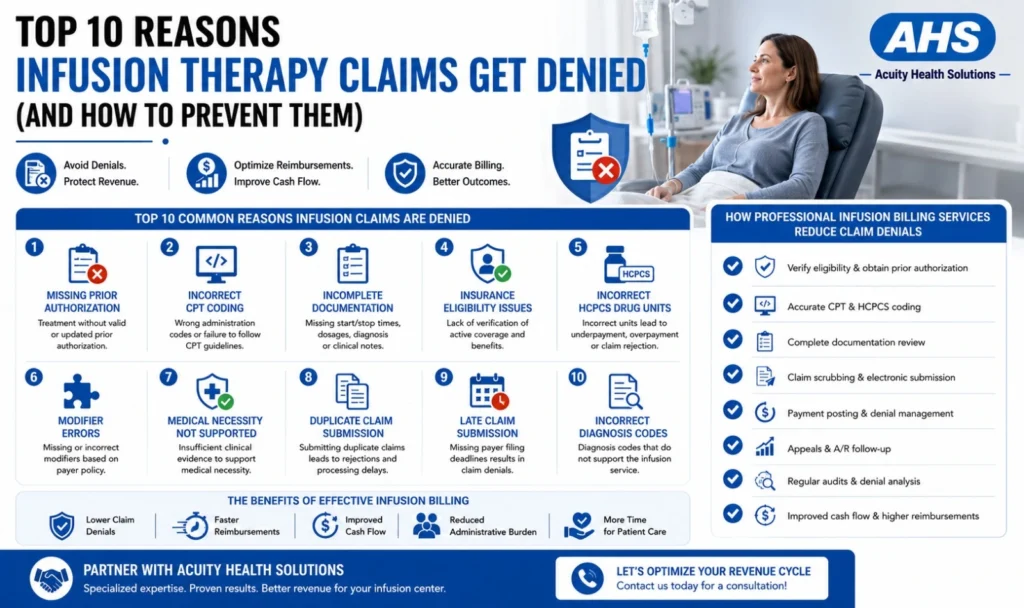
The billing process for infusion therapy is one of the most complex in Medical Billing, featuring time-based CPT coding, drug administration guidelines, prior authorization needs and payer-specific guidelines. Billing mistakes, no matter how small, can lead to claim denials, delayed reimbursements, and lost revenue.
Having the knowledge of the most frequent denial causes can help infusion centers and specialty practices enhance their billing procedure in addition to improving their financial outcomes.
Why Are Infusion Therapy Claims Frequently Denied?
Infusion Therapy Claims have several different billing components, all of which need to be matched. Providers should properly document the administration of drugs, choose the correct CPT and HCPCS codes, check insurance coverage, and show medical necessity.
There is no universal method for determining the acceptability of a claim, and it may be accepted by some payers only to be denied by other payers based on differing policies. Benefits and avoidable denials are prevented, and reimbursement is kept on track with a well-managed infusion revenue cycle.
Several drugs are given by infusion that need insurance approval before treatment. Without prior authorization or if it has expired, this claim will most likely not be paid, even if the clinical outcome is favorable.
2. Incorrect CPT Coding
A claim may be denied or may not be paid if the wrong administration code is used or if the guidelines of the hierarchy of CPT are not followed.
3. Incomplete Documentation
When infusion start times, stop times, drug dosages or diagnosis information is missing, or notes regarding clinical findings are not included, it is hard for payers to determine if the service was provided.
4. Insurance Eligibility Issues
Without verification of active insurance and patient benefits before treatment, there is often unnecessary denial and patient balancing.
5. Incorrect HCPCS Drug Units
If HCPCS drug units are incorrectly billed, it can result in underpayment, overpayment or claim rejection from the insurance payer.
6. Modifier Errors
Service is provided incorrectly or without the required modifiers may result in claims being denied based on the payer’s policy.
Related Resource
Modifier 25, 59 & X Modifiers: Compliance Risks and Correct Usage Learn when to use Modifier 25, Modifier 59, and X Modifiers correctly to improve coding accuracy, reduce claim denials, and stay compliant with payer guidelines.
The rationale for the need for infusion therapy should be explained in clinical documentation. When there is not enough medical necessity for a claim, it is often denied.
8. Duplicate Claim Submission
Double claiming can lead to rejection of claims, unnecessary claims and admin delays.
9. Late Claim Submission
Each and every payer has filing deadlines that must be obeyed. Failure to meet these deadlines typically means the claim will be denied and won’t be paid, despite proper treatment.
10. Incorrect Diagnosis Codes
The diagnosis codes should be used correctly to support the infusion service provided.
How Professional Infusion Billing Services Reduce Claim Denials
Working with a proven Infusion Billing Services provider enables practices to enhance billing accuracy across the revenue cycle. Certified Medical Billing Specialists are familiar with the infusion coding guidelines, payer policies and documentation standards.
They help with eligibility, prior authorization, proper CPT and HCPCS coding, claim scrubbing, electronic claim submission, payment posting, denial appeals and A/R follow-up.
Recurring issues can be proactively identified through regular billing audits and proactive denial analysis that help avoid the impact on cash flow.
By having a structured Infusion Medical Billing process, providers can not only enhance the rate of clean claims, but also optimize the time they can dedicate to patient care while also reducing administrative burdens and speeding up reimbursement.
Related Resource
Complete Guide to Reducing Medical Billing Claim Denials Learn practical strategies to reduce denials and improve reimbursement outcomes.
Effective Infusion Therapy Billing is more than just submitting claims; it’s about specialty expertise, compliance, and ongoing RCM monitoring.
Acuity Health Solutionsprovides end-to-end Revenue Cycle Management services, specialized account managers, coding knowledge, denial management and optimization of reimbursements to infusion centres and healthcare providers.
We can help you enhance your billing process and boost your bottom line if you’re facing increased claim denials or delays in claims payments.
Typical causes are lack of authorization, coding errors, lack of documentation, eligibility and medical necessity concerns.
What is the documentation needed to bill for infusion services?
Documentation should contain diagnosis, medical necessity, infusion start and stop time, medications administered, route of medication and physician notes.
What are the common billing problems with infusion therapy?
Some of the most common errors include coding, drug units, modifier errors, duplicate claims, late claims, and documentation errors.
What documentation is required for infusion billing?
Infusion billing requires physician orders, medical necessity, diagnosis codes, drug details, infusion start and stop times, nursing notes, and any required prior authorization.
How do you bill for infusion services?
Verify insurance eligibility, document the infusion accurately, assign the correct CPT and ICD-10 codes, apply necessary modifiers, and submit the claim according to payer requirements.
What is the CPT code for infusions?
Common infusion CPT codes include 96365 for the initial therapeutic infusion, 96366 for each additional hour, 96367 for sequential infusions, and 96368 for concurrent infusions.
What are the three types of infusions?
The three main types of infusions are therapeutic infusions, hydration infusions, and diagnostic or prophylactic infusions, each with its own billing and coding requirements.
TheAHS Editorial Teamdelivers accurate, well-researched, and industry-focused healthcare content to support healthcare providers and organizations. Through reliable insights and healthcare expertise, we help organizations improve efficiency, maintain compliance, and stay informed about the evolving healthcare industry.