

If you’ve ever stared at a denied claim wondering whether you used 90834 or 90837, you’re not alone — it’s one of the most common mix-ups in behavioral health billing. This guide walks through the CPT codes Texas providers use most, what they actually cover, and where Texas Medicaid adds its own twist.
Quick answer: Behavioral Health Billing in Texas relies on a mix of standard CPT codes (90791, 90832–90838, 90846–90853) for evaluation and psychotherapy, plus Texas Medicaid-specific HCPCS codes like H0031 and H2019 for certain community-based services. Getting the code, the session length, and the documentation to match is what keeps claims from bouncing back.
Evaluation Codes
90791 — Psychiatric diagnostic evaluation, no medical services. Used by therapists, psychologists, and counselors for the initial intake assessment.
90792 — Same evaluation, but with medical services included. This is the version psychiatrists and prescribing providers bill, since it covers the medical component of the assessment.
Only one of these gets billed per intake, not both — and most payers won’t reimburse a second evaluation code for the same patient without a real gap in treatment.
Individual Psychotherapy Codes
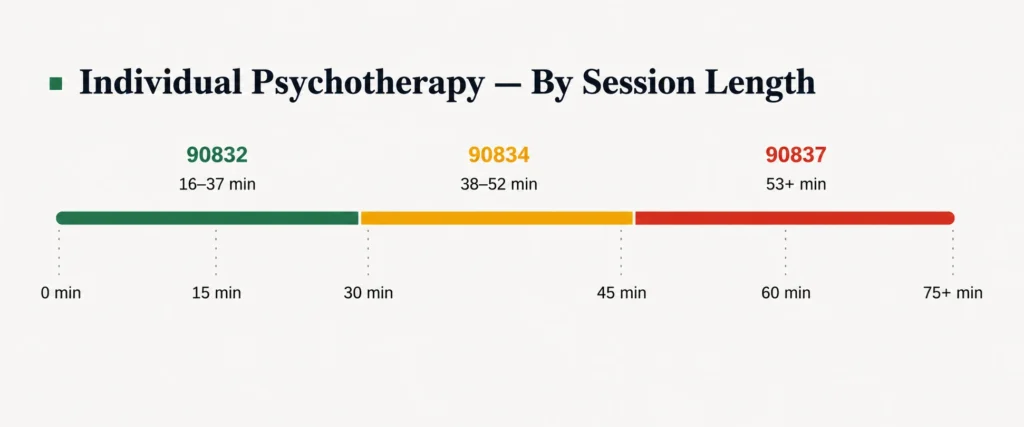
This is where a lot of denials happen, because these codes are entirely time-based:
| Code | Session Length | Notes |
| 90832 | 30 minutes (16–37 min) | Shorter sessions |
| 90834 | 45 minutes (38–52 min) | Most common individual session |
| 90837 | 60 minutes (53+ min) | Longer sessions, more heavily audited |
The code has to match what’s documented in the session note — not what’s typically billed, not what insurance “usually” pays for. 90837 in particular draws more payer scrutiny than the other two, simply because it reimburses more, so documentation needs to clearly support the full session length.
Add-On Codes for Medication Management Visits
When a psychiatrist or prescriber does psychotherapy alongside a medical evaluation and management (E/M) visit — say, a med check plus a supportive therapy component — the psychotherapy portion gets billed as an add-on code, not a separate CPT:
- 90833 — 30 minutes, add-on to an E/M code
- 90836 — 45 minutes, add-on to an E/M code
- 90838 — 60 minutes, add-on to an E/M code
These always pair with an E/M code (like 99213 or 99214) — they’re never billed alone.

Group and Family Therapy Codes
90853 — Group psychotherapy. Billed once per patient in the group, not once per group session.
90846 — Family psychotherapy without the patient present.
90847 — Family psychotherapy with the patient present.
Psychological Testing Codes
For practices that do formal testing, 96130/96131 cover the evaluation and interpretation of psychological test results, while 96136/96137 cover the actual test administration and scoring. These are billed in timed units, which is a common place practices under- or over-bill without realizing it.
Texas Medicaid’s Own Codes
Standard CPT codes cover most billing, but Texas Medicaid also uses HCPCS codes for certain community-based behavioral health services that fall outside typical CPT definitions — most commonly H0031 (mental health assessment) and H2019 (therapeutic behavioral services), as outlined in the TMHP Behavioral Health and Case Management Services Handbook.
If your practice bills Texas Medicaid directly or through an MCO, it’s worth checking whether a service should be billed under CPT or under one of these HCPCS codes instead — using the wrong one is a quiet but common denial cause.
Telehealth Billing in Texas
Behavioral health leans on virtual visits more than almost any Other Specialty, and telehealth billing has its own coding logic separate from the CPT codes above.
POS 02 — Telehealth Provided Other Than in Patient’s Home. Use this when the patient is somewhere other than home during the visit — an office, a clinic, a school setting. This triggers the lower facility rate.
POS 10 — Telehealth Provided in Patient’s Home. CMS added this code in 2022 specifically for patients receiving care from home. It triggers the higher non-facility rate — the same rate as an in-person office visit.
These two aren’t interchangeable, and mixing them up doesn’t usually bounce the claim back as an obvious error; it just quietly pays out at the wrong rate.
A 45-minute telehealth session (90834) billed with POS 02 when the patient was actually home gets reimbursed less than it should, on every single claim, without anyone necessarily noticing until someone audits the pattern.
Modifier 95 goes alongside the POS code, not instead of it. It confirms the visit was real-time, interactive audio-video telehealth — payers use it to recognize the encounter as synchronous, which matters for whether it’s covered at all.
Prevention: Confirm and document exactly where the patient was located at the start of every telehealth visit, and match the POS code to that location — not to habit or whatever was billed last time.
Why This Trips Practices Up
The codes themselves aren’t complicated. What’s complicated is the layering: matching session time to the exact code, knowing when a code needs to be paired with an E/M visit instead of standing alone, and knowing when Texas Medicaid wants a HCPCS code instead of the CPT code a commercial payer would expect for the same service. Miss any one of these, and the claim comes back.
Why Choose Acuity Health Solutions
Acuity Health Solutions coders specialize in behavioral health, with direct experience across Texas Medicaid, MCOs, and commercial payers.
We match session documentation to the right code the first time — reducing the coding-related denials that eat into a practice’s time and revenue. Talk to our team about your behavioral health billing.
Frequently Asked Questions
What's the difference between 90834 and 90837?
Session length — 90834 covers roughly 38–52 minutes, 90837 covers 53 minutes or more, and documentation has to support whichever is billed.
Can 90791 and 90792 both be billed for the same patient?
No — only one applies, depending on whether medical services were part of the evaluation.
Do add-on codes like 90833 get billed alone?
No, they must always accompany an E/M code from the same visit.
Does Texas Medicaid use different codes than commercial insurance?
Mostly the same CPT codes, but certain community-based services use Texas-specific HCPCS codes like H0031 and H2019 instead.
Helpful Links -: