

While many Dermatology Medical Billing practices don’t know it, they lose money. Revenue leakage can happen throughout the entire revenue cycle – from patient registration to insurance verification, coding through to claim submission, and payment posting.
Quick answer: A useful dermatology RCM audit follows one claim from scheduling through final payment, then measures the same controls across the full population. Review front-end data, documentation, coding, edits, denials, contractual adjustments, credits, patient balances, and aging by payer and provider.
A Dermatology Revenue Cycle Audit Checklist provides a structured approach for practices to uncover hidden inefficiencies, minimize claim denials, and maximize revenue before minor problems turn into major problems.
Why Dermatology Practices Need Regular Revenue Cycle Audits
Cosmetic versus Medical Billing, increasing scrutiny by payers, high patient volume, and complex billing requirements are just some of the dermatology billing issues a dermatology practice encounters.
Compliance risk assessment, reimbursement gaps and operational inefficiencies can be detected through regular RCM audit processes in the Dermatology Speciality and can contribute to the sustained revenue growth.
What Is a Revenue Cycle Audit?
A Revenue Cycle Audit is an in-depth examination of the entire revenue cycle. A full Dermatology Revenue Cycle Management audit involves reviewing all the front-end processes, coding accuracy, denial management, as well as accounts receivable and payment posting performance. The aim is to spot gaps in the collections prior to their affecting the collections.
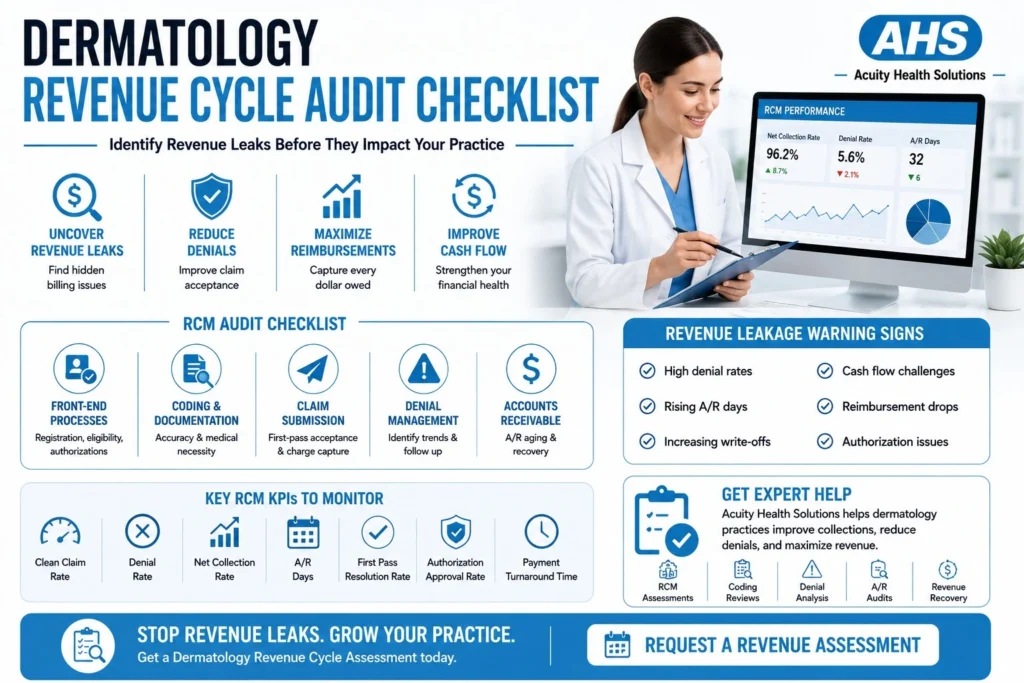
Front-End Revenue Cycle Audit Checklist
Patient Registration Accuracy
Check for duplicate records, insurance information and demographic errors.
Insurance Eligibility Verification
Ensure that coverage validation, benefit verification and coordination of benefits are in place.
Prior Authorization Processes
Review and audit authorizations that have been lost and those that have not been given.
Audit Questions:
- Do demographics of patients checked prior to appointments?
- Are insurance benefits for visits confirmed?
- Is there proper documentation of previous authorisations?
Coding and Documentation Audit Checklist
Documentation Completeness
Review procedure documentation, medical necessity documentation and consistency of medical notes.
CPT, ICD-10, and Modifier Accuracy
Discuss the relevance of coding specificity, using modifiers, and linkage of the diagnosis to the procedure.
Common Dermatology Coding Risk Areas
Concentrate on biopsies, lesion removals, Mohs surgery and cosmetic services.
Claim Submission Audit Checklist
Claim Submission Audit Checklist
Monitor first-pass acceptance rates and trends of rejections, and any clearinghouse-related clearance problems.
Charge Capture Review
Catch unfilled charges, unentered charges and incomplete encounters.
Denial Management Audit Checklist
Review Denial Trends
Examine the leading denials, denials by specific payers and denials that can be avoided.
Appeals and Follow-Up Processes (FUP)
Check appeal success rates and consistency of follow-up.
Accounts Receivable Audit Checklist
A/R Aging Review
Conduct a review of ageing buckets, claims outstanding and balances at high-level trouble.
Follow-Up Effectiveness
Evaluate the collection, escalation and recovery rates.
Payment Posting and Underpayment Audit Checklist
Payment Accuracy Review
Spot when payments are too low, when payments are not made up correctly and when payments are not made at all.
Review EFT and ERA Setups
Evaluate and measure payment reconciliation and posting effectiveness.
Revenue Leakage Warning Signs Every Dermatology Practice Should Monitor
Signs of trouble are denial rates, A/R days, more and more write-offs, cash flow problems, unexpected decreases in reimbursements, and lots of authorization problems. These are key indicators that can point to the presence of underlying Dermatology revenue leakage.
Key Revenue Cycle KPIs to Include in Your Dermatology Audit
Monitor:
- Clean Claim Rate
- Denial Rate
- Net Collection Rate
- A/R Days
- First Pass Resolution Rate
- Authorization Approval Rate
- Payment Turnaround Time
When to Consider a Professional Dermatology Revenue Cycle Assessment
If a Dermatology practice is facing ongoing denials, revenue loss, staffing problems, payer problems or rapid growth, a professional revenue assessment for a Dermatology practice may be helpful.
How Acuity Health Solutions Helps Dermatology Practices Identify Revenue Leakage
Their services include revenue cycle assessments, coding reviews, denial analysis, A/R audits and revenue recovery strategies from Acuity Health Solutions. Our customised method will assist dermatology practices in enhancing collections, minimising denials and boosting financial results.
Conclusion
Little billing mistakes can amount to big financial losses in the long run. Frequent audits enhance transparency of practice performance, help ensure reimbursement is maximized and boost long-term RCM efficiency.
If you’re not sure where your revenue is going, you should find out.
Get a Dermatology Revenue Cycle Assessment and discover billing issues and revenue leakages and enhance your practice’s profitability.
Related resources
Continue with our dermatology billing challenges, modifier 25 guidance, revenue cycle assessment.
Need help with this workflow? Talk with Acuity Health Solutions about billing, credentialing, or revenue-cycle support.
Frequently asked questions
How often should a dermatology RCM audit be performed?
Monitor core KPIs monthly and perform a deeper process and sample-based audit at least annually or after a material payer, staffing, or system change.
How large should the claim sample be?
Use a risk-based sample across payers, providers, services, locations, paid claims, denials, and adjustments; a single convenient sample can hide systemic issues.
Which KPIs should be included?
Include clean-claim rate, denial rate, days in A/R, aging, net collection rate, underpayments, credits, and patient-balance performance.
Who should own audit findings?
Each corrective action needs one accountable owner, due date, evidence of completion, and a follow-up measure.
When is an external audit useful?
Use independent review when internal resources are limited, the issue crosses departments, compliance risk is elevated, or leadership needs an objective baseline.