
There are many changes taking place in Texas—more payers reviewing dermatology claims, stricter reimbursement policies and higher documentation requirements. Post-definition, current practices must handle complex workflows that combine E/M services, dermatological procedures, modifiers and payer-specific policies.
The prior authorization process has become more onerous, and clinics in Texas struggle with cosmetic versus medically necessary services. These problems can lead to delays in operations, reimbursements and increase denials.
Accurate billing in dermatology is where specialized dermatology Medical Billing Services can add value to a dermatology practice and minimize revenue loss.
Most Common Billing Problems Faced by Texas Dermatology Practices
Challenges faced by Texas-based dermatology practices:
- Modifier-related claim denials
- Wrong or incomplete records
- What happens when someone confuses a medical bill with cosmetics?
- What happens when cosmetic versus medical billing gets mixed up?
- Solving the eligibility verification challenges in plan coverage for insurance
- Coding inaccuracies
- Payer-specific billing variations
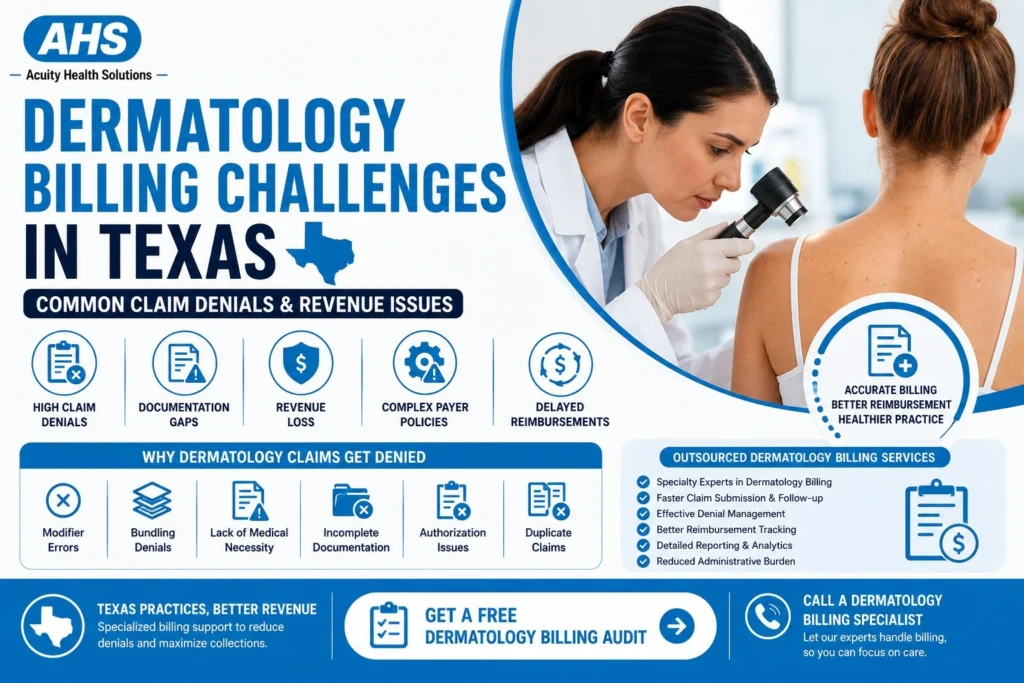
Why Dermatology Claims Get Denied in Texas
Claim denials are still one of the top financial issues for dermatology practices. Typical reasons for not admitting are:
- Modifier 25 errors
- Bundling denials
- Failure to support the medical necessity of services.Failure to document medical necessity for services.
- Inability to complete the records (may result from the loss or lack of records)
- Incorrect diagnosis coding
- Authorisation-related denials
- Duplicate claim submissions
Why Cosmetic and Medical Dermatology Billing Creates Complexity
Cosmetic services and medically indicated services are provided in dermatology practices, and this adds to the billing complexity. Most cosmetic procedures are self-pay procedures, and medical necessity procedures require detailed insurance documentation and medical necessity support.
This overlap presents problems with:
- Insurance coverage limitations
- Confusion about patient financial responsibilities.
- Documentation inconsistencies
- Prior authorization requirements
- Compliance risks
How Billing Inefficiencies Reduce Practice Revenue
Efficient billing harms dermatology practice revenue in the following ways:
- Denied claims
- Underpayments
- Delayed reimbursements
- Coding errors
- Weak follow-up processes
Denial rates always matter; even a small increase can affect the monthly collections and cash flow. Unresolved billing issues also cause a rise in operational inefficiency and administration burden over time.
Eliminating claim denials by following medical billing best practices improves practices’ Revenue Cycles Management.
Texas Insurance and Payer Challenges in Dermatology Billing
Many practices in Texas find it necessary to deal with a variety of commercial insurance programs, Medicaid, and speciality-specific payers’ rules.
Challenges include:
- Commercial payer variability
- Medicaid documentation complexities
- Prior authorization requirements
- Inconsistent reimbursement policies
- Increased audit risks
Practices need to be vigilant and watchful about the evolving requirements of payers in addition to managing the volume of claims and ensuring compliance.
Benefits of Outsourced Dermatology Billing Services
There are multiple benefits to outsourcing dermatology billing:
- A chance at a speciality Dermatology Billing Specialist.
- Quickest possible claims are submitted and acted upon.
- Claims are submitted and processed as quickly as possible.
- Improved denial management
- Better reimbursement tracking
- Reduced administrative burden
- In-depth reporting and analytics
Collaborating with an experienced outsourced medical billing service can enhance collections and minimize stress as well. Medical Billing Pricing should also be thoroughly looked at to ensure high ROI in practices.
How Texas Dermatology Practices Can Improve Billing Efficiency
The dermatology clinic should prioritize the following aspects to enhance billing performance:
- Regular coding audits
- Stronger documentation workflows
- Denial tracking systems
- Accurate eligibility verification
- Payor policy monitoring is a continuous process
- Speciality-focused billing support
By applying best practices for eligibility verification, you can minimize billing problems downstream and speed up reimbursements.
Enhance Revenue and Decrease Billing Mistakes in Dermatology Practices
In the state of Texas, third-party billing solutions are gaining acceptance as companies seek to optimize their processes and increase revenue generation. Texas outsourced billing is being done by many business companies to increase their productivity, reduce revenue loss and establish more sustainable growth in the future.
We are there for you if you need help with Dermatology Billing in Texas.
Discover how dedicated dermatology billing assistance can help you cut down denials, maximize reimbursements and take your revenue cycle to the next level.