

Being a good dermatologist is not just being able to take good care of your patients. The changes in payer policies that can impact revenue and operational efficiency, and coding complex requirements, claims denials and staff shortages all fall under the periphery of these challenges.
Why is Dermatology Billing Harder than Other Medical Specialities?
High volume procedures, biopsies, excisions, Mohs surgery, Modifier usage and multiple diagnosis codes combinations are part of dermatology billing. In addition, practices need to accommodate multiple Medicare compliance requirements, commercial payer requirements, and stay current with the ever-changing coding landscape. These are all the reasons why dermatology billing is considered one of the more complicated medical specialities.
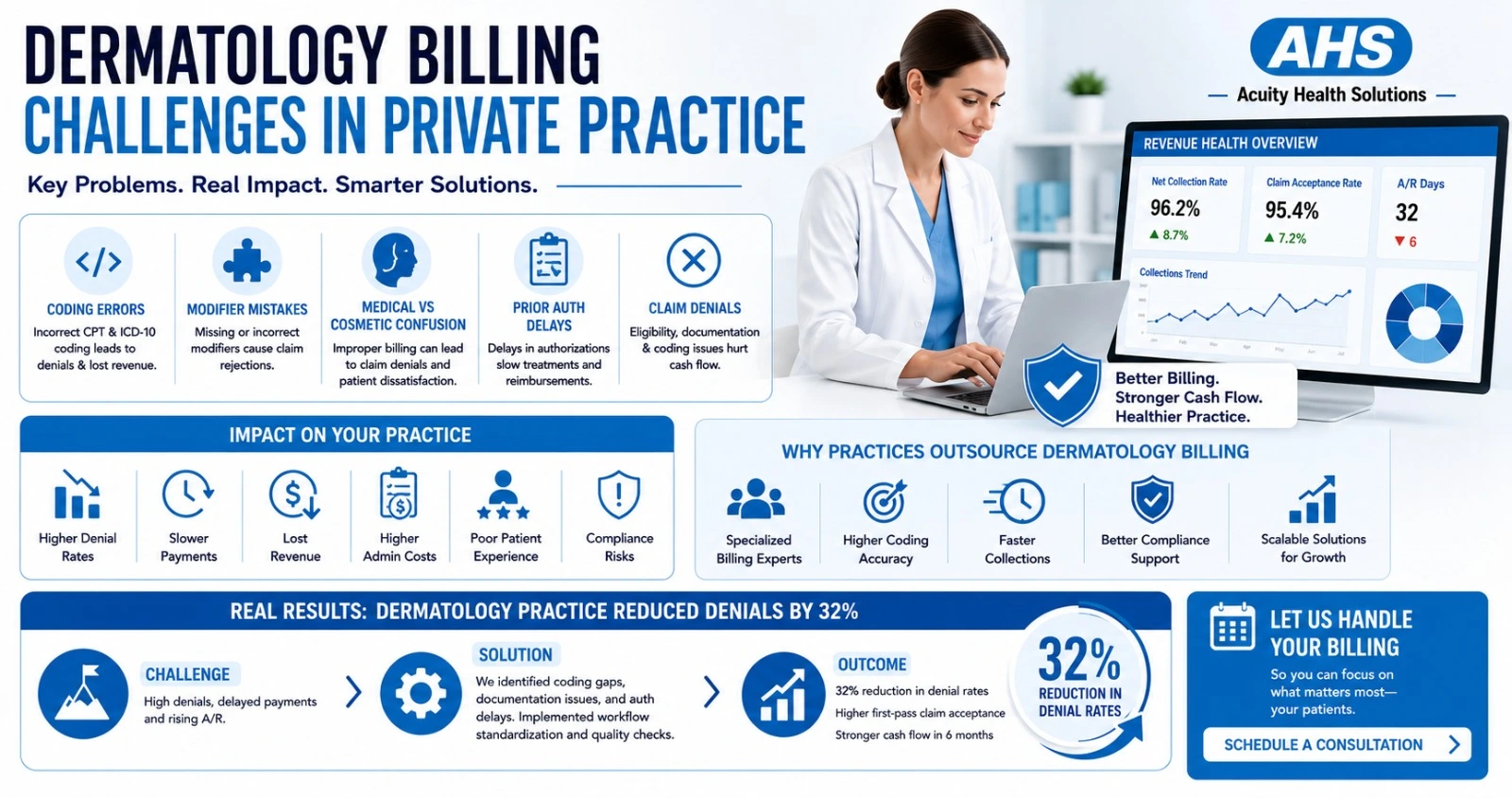
The Biggest Dermatology Billing Challenges in Private Practice
Incorrect CPT & ICD-10 Coding
Coding errors still continue to be one of the major reasons for claim denials. Common problem areas are the selection of wrong CPTs, mismatched diagnosis, insufficient specificity of coding and outdated coding. These errors may result in denials and may cause underpayments and compliance issues. These risks can be minimized with regular coding audits and certified dermatology coders.
Modifier Errors
In dermatology, one can frequently encounter modifiers like 25, 59, 51 and LT and RT. When claims are denied for missing modifiers, incorrect combinations or lack of documentation—claims that need more specificity to be processed correctly. Continuing provider education and quality assurance reviews can enhance accuracy.
Medical vs Cosmetic Billing Confusion
This can cause billing issues for such services as Botox, chemical peels, laser and cosmetic lesion removal. Cosmetic claims can be rejected and patients can be unhappy if wrongly billed to insurance. Good documentation and communication will be a must.
Prior Authorization Delays
Typical examples of services that require prior authorization include biologics, specialty medications, Mohs surgery, and advanced procedures. Such delays can lead to delayed treatments, missed appointments, and delayed revenue. Dedicated authorisation — for dedicated workflows that help avoid redundancy.
Learn More -: Healthcare Operations Support
Increasing Claim Denials
Denials due to eligibility, coding errors, documentation issues and lack of authorisations, as well as late filing, are among the most common denial reasons. The higher the approval bidding rate of your accounts, the lower the cash flow, thus further increasing outstanding accounts in a more prolonged time frame.
Documentation Doesn’t Support Coding
Not quantifying lesions, partial or inadequate procedure reports, lack of documentation for medical necessity, and insufficient follow-up notes could downcode claims. There is mature clinical documentation, accurate codes that can be billed out and reimbursed.
Learn More -: Clinical Coding Services
Technology & EHR Challenges
Oftentimes, inefficiencies in workflow design, incorrect template use, duplicate documentation and manual billing procedures are responsible for impacting revenue cycle performance.
How Billing Challenges Affect Private Practice Revenue
Billing issues may result in:
- Higher denial rates
- Slower payments
- Lost revenue
- Increased administrative costs
- Poor patient experience
- Reduced provider productivity
- Compliance risks
- Greater audit exposure
Warning Signs Your Dermatology Practice Has Billing Problems
Increased A/R balances, a higher denial rate, slow collections, frequent coding questions, revenue stability that is all over the place (the key to stable revenues is a great coding team), too many bills left for staff, a low first pass acceptance rate and repeated requests from payers are signs to be on alert.
The Reason Why a Great Number of Private Practices Outsource Dermatology Billing
Outsourcing provides specialist billers, higher coding accuracy, expedited collections, better-staffed solutions, improved compliance support and scalable operations together to diminish administrative burden altogether.
What Makes Acuity Health Solutions Unique
At Acuity Health Solutions, we understand billing and more about dermatology. We are experts on the prevention of denials, increasing the precise amount of reimbursements, preventing revenue loss due to errors in proper documentation and improving billing workflows.
Dedicated specialists serve the clients, having an intimate knowledge of the dermatology industry’s needs and supporting practices with their financial performance and operations.
Case Study: How a Dermatology Practice Reduced Denials by 32%
Challenge
As a growing dermatology practice, denials, delayed payments and rising accounts receivable were the challenges they faced.
Solution
During a detailed billing review, coding inconsistencies, documentation gaps and authorization issues were identified. Standardisation of workflows and quality checks was introduced.
Outcome
The 32% drop in denial rates, 1st pass claim acceptance and more predictable cash flow within 6 months helped.
Stop Letting Billing Challenges Reduce Your Dermatology Practice Revenue
Billing issues do not necessarily go away. Denials, coding problems, staffing shortages, and fluctuating cash flow can be issues in an increasing practice, and Acuity Health Solutions can help determine the cause and create long-term solutions that will enhance the revenue cycle.