

Many healthcare practices think that they have a successful revenue cycle when they submit claims and get paid on a regular basis. But there are many hidden revenue leakage points that lie below the surface. Over time, claims denials, underpayments, ageing of accounts receivable, authorization issues, and inefficient workflows can all hurt profit quietly.
By conducting a Revenue Cycle Assessment, healthcare organizations can gain insights into their current financial performance and identify areas for improvement. Even if you have a private practice or a medical centre with several doctors, knowing the signs of trouble can help ensure the ongoing success of your practice and revenue stability.
Need a comprehensive look into your Billing Practices? Discover our Revenue Cycle Management Services and discover any hidden revenue leakage to enhance collections.
What Is a Revenue Cycle Assessment?
Revenue Cycle Assessment is an in-depth examination of the entire billing and Reimbursement cycle for a healthcare practice. An RCM Audit serves to uncover revenue leakage, compliance risks and inefficiencies in workflow and reimbursement issues that impact collections and finances.
Usually covered areas are:
- Patient scheduling
- Insurance verification
- Prior authorizations
- Charge capture
- Coding accuracy
- Claims submission
- Denial management
- Accounts receivable
- Payment posting
- Reporting and analytics
There are many Healthcare Practices that don’t notice when the collections drop off significantly, and that’s when they realize that there is a problem with the billing. A proactive Revenue Cycle Audit can help identify problems in advance and prevent significant financial losses.
Why Healthcare Practices Conduct Revenue Cycle Audits
Healthcare Revenue Cycle Management directly impacts cash flow, efficiency and profitability.
Practices carry out RCM audits to:
- Identify revenue leakage
- Reduce claim denials
- Improve reimbursement accuracy
- Strengthen compliance
- Improve cash flow
- Increase operational visibility
- Support long-term growth
Good billing procedures can lead to better consistency in collections and less denials.
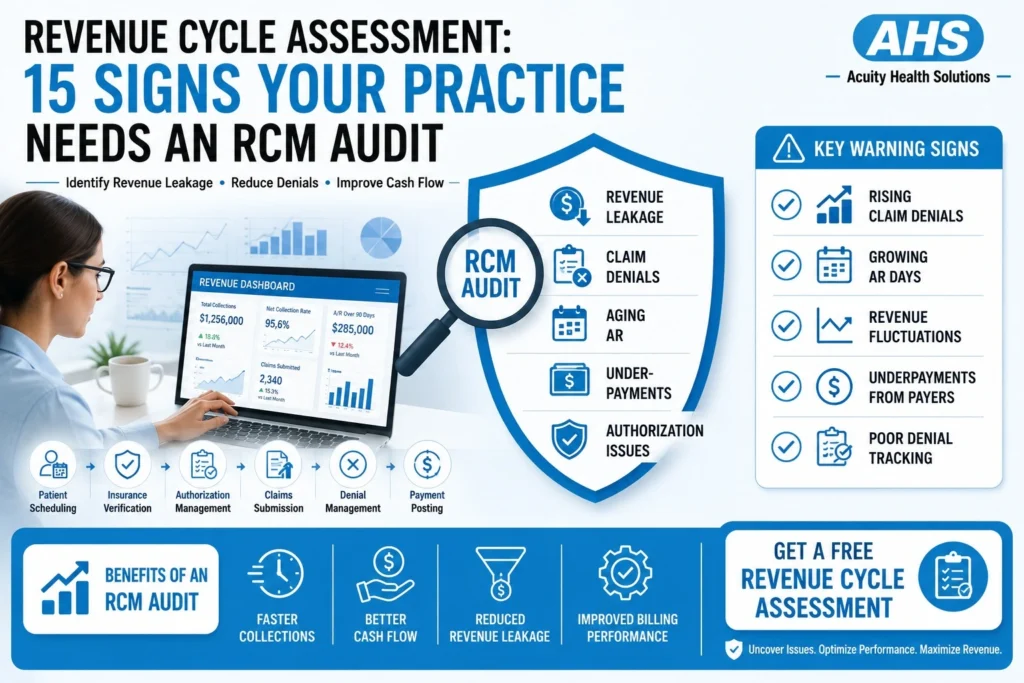
15 Signs Your Practice Needs an RCM Audit
Here are the signs that your practice requires an RCM Audit –
1. Claim Denials Continue to Increase
A rise in denial rates usually indicates larger workflow problems rather than just claim issues. More Denials = More Rework, Lower Collections & Delayed Payments.
2. Includes Accounts Receivable Growing Monthly
High AR in the last 3 months, aged claims, and unworked claims are visible indications of business ineffectiveness and profit loss.
3. Revenue Feels Unpredictable
If collections are swinging from one month to the next with no apparent reason, then your practice may not have the visibility and/or revenue cycle forecasting accuracy.
4. Prior Authorization Issues Frequently Affect Payments
Insurance companies may deny claims or take longer to reimburse practices when authorizations are missing or inaccurate. We need to constantly evaluate the team-based authorisation workflows.
5. You Suspect Insurance Underpayments
Across many practices, monitoring contracts with payers and variances in payment often result in an underpayment.
6. Timeliness Denials Becoming Routine For You
Late claims and the absence of follow-ups become default write-offs, losing revenue.
7. No-Hand Raise First-Pass Claim Acceptance Rates Are Down
This results in low claim pay rates and increased reimbursement time as clearinghouses reject many claims, and also often code incorrectly, along with poor documentation.
8. More Time is Spent Fixing Errors than Avoiding Them
Billing environments that only react indicate inefficiencies in workflows and weak process controls.
9. Reimbursement is Impacted by Errors in Eligibility Verification
If coverage verification fails or the process of catching patient eligibility mistakes is not in place, it can lead to downstream denials and delayed payments.
10. Revenue Reports Lack Visibility
When practices lack proper KPIs and a mechanism to track performance, catching those lost revenue trends can be challenging at best, and often not possible.
11. Analytics for Denials
Denials have no classification, and monitoring practices cannot provide the trending of various types of denials and common denial mistakes without objectively based analytics.
12. Collections Are Not Growing with Patient Volume
A rising number of patients seen but a shrinking number collected might be potential indicators of revenue leakage in the billing process itself.
13. Your Practice Has Experienced Billing Staff Turnover
Frequent staff changes can cause workflow issues, knowledge gaps, loss of coding standardization, and increased claims error rates.
14. Your Practice Has Recently Expanded
The more providers, locations, and services that are added, the more complex the payers are and the more they pose an operational risk, and the more critical RCM oversight becomes.
15. You’ve Never Performed an RCM Audit
Most healthcare practices go for years without a formal assessment, and inefficiencies and lost revenue opportunities occur without anyone ever being the wiser.
What Areas Are Reviewed During an RCM Audit?
Front-End Revenue Cycle
The front-end workflows are a major factor in accurate reimbursement and collections.
Areas reviewed include:
- Scheduling
- Patient registration
- Eligibility verification
- Prior authorizations
Billing issues could arise downstream even if there is only a small error in the intake.
Mid-Cycle Operations
Mid-cycle reviews are based on:
- Documentation accuracy
- Coding quality
- Charge capture
- Claim generation
All of these workflows have a profound impact on clean claim rates and reimbursement speed.
Back-End Revenue Cycle
Back-end assessments evaluate:
- Denial Management
- Appeals workflows
- AR follow-up
- Payment posting
- Underpayment analysis
So, in order to have consistent collections as well as minimization of ageing AR, back-end operations can be optimized based on this information.
Common Issues That Are Often Discovered in Revenue Cycle Assessments
Revenue cycle assessments may uncover issues with your processes and procedures related to both care delivery & finance, including:
- Revenue Leakage
Non-captured refunds, non-processed claims and open denials impact profits.
- Coding Errors
If you code incorrectly, then you have denials, underpayments and compliance risks.
- Missing Prior Authorizations
Claims are quite frequently denied for authorization reasons, and reimbursements are delayed.
- Aging AR Problems
Accounts that have not yet been worked on or followed up on create problems for cash flow.
- Underpayments
These discrepancies can often go undetected without payment analysis because by the time the contract reaches the revenue cycle teams.
- Poor Denial Tracking
Lack of denial categorization means no ongoing billing optimization.
- Weak Reporting Infrastructure
The lack of reporting visibility affects operational decision-making accuracy.
Key Benefits of a Revenue Cycle Assessment
A professional Revenue Cycle Assessment provides:
- Improved revenue visibility
- Reduced claim denials
- Faster collections
- Better cash flow
- More predictable revenue
- Improved operational efficiency
- Stronger billing compliance
Revenue cycle management practices that take proactive measures towards performance monitoring are well placed to sustain growth.
How Often Should Practices Carry Out an RCM Audit?
Healthcare practices should consider performing Revenue Cycle Audits:
- Annually
- After practice expansion
- Following EHR implementation
- After staffing changes
- When denial rates increase
- Prior to moving to Outsource Billing functions
Practices benefit from regular audits, which help to spot issues early on so that revenue loss is prevented from becoming increasingly severe.
How Acuity Health Solutions Helps Practices Identify Revenue Leakage
Acuity Health Solutions conducts in-depth Revenue Cycle Assessments to identify and analyze each step in the reimbursement process.
Our services include:
- Revenue leakage analysis
- RCM audits
- Denial trend reviews
- AR assessments
- Prior authorization workflow analysis
- Coding and billing reviews
- Payment variance analysis
- Operational workflow optimization
A provider evaluation may help identify mystery problems and lead to greater financial stability for practices dealing with elevated denials, AR aging patterns, fluctuating collections rates, and a lack of visibility into revenue performance.
Conclusion
Healthcare organizations see lost revenue without even realizing it. Issues such as claim denials, underpayments, aging AR, authorization issues and inefficient workflows can slowly erode your margins for years.
Revenue Cycle Assessments do these things by providing the visibility needed to identify operational weaknesses, increase billing performance and collections, and build a more predictable revenue cycle. Regular RCM audits are one of the best ways to protect a solid revenue and steady cash flow for any healthcare practices striving towards long-term growth.