

Behavioral health practices are more prone to reimbursement issues compared to other Medical Billing Specialities in the medical space. Forces leading to delays in payment cycles and denials include payer scrutiny, complex authorizations, telehealth payment requirements, and documentation requirements.
Most of the mental health care has some administrative hassle, which reflects cash flow along with efficiency. Even minor errors on bills can lead to long lay times with providers receiving their reimbursement. For this reason, a plethora of practices are taking advantage of advanced Behavioral Health Medical Billing Services that facilitate precise claims and decrease the chances of delayed payments in most cases.
Most Common Behavioral Health Billing Problems
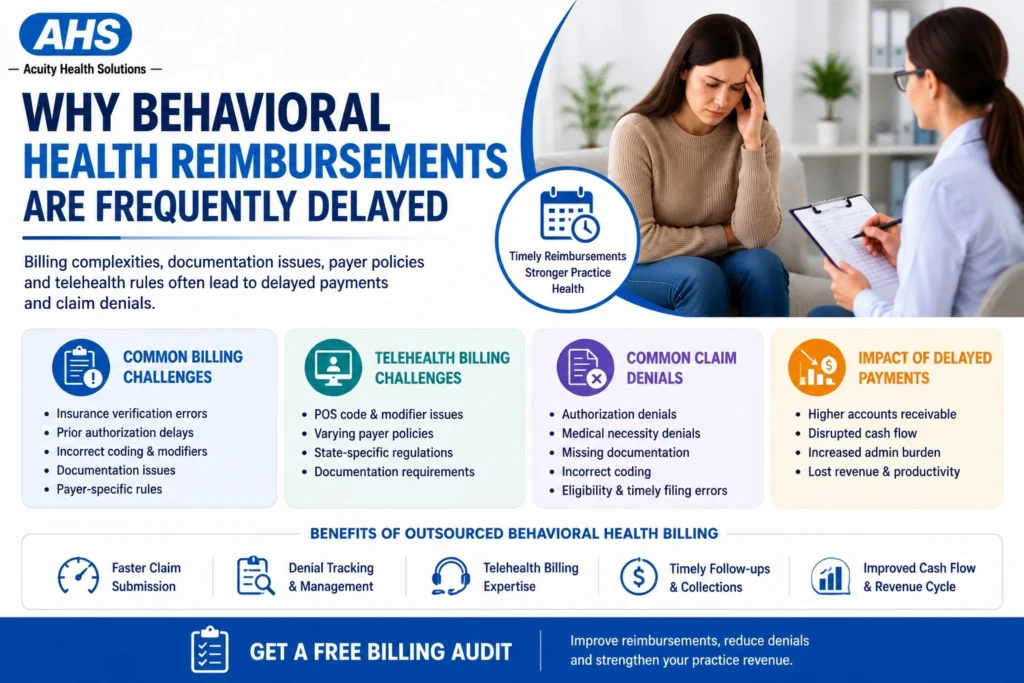
There are some common problems in Behavioural Health Billing that cause delayed claims and denials. Some frequent issues are errors in verifying the insurance, prior authorizations that are delayed, incorrect modifier application, documentation problems, eligibility issues, coordination of benefits issues, and specific billing rules for each payer.
A new wrinkle has been added with the telehealth services, particularly as there are different coding and reimbursement rules from different payers. Such billing issues lead to greater administration burden and negatively impact practice revenue cycles.
Telehealth Billing Challenges That Affect Behavioral Health Reimbursements
Tele-behavioral Health Billing is still in a state of flux and is causing confusion for many practices. During a virtual visit, providers often experience confusion with the POS code, modifier issues, and payer policies that vary from one to another, as well as documentation issues.
The rules for telehealth billing differ from one insurer to another and from state to state, and so can cause delays in reimbursement when claims are not submitted properly. Knowing the common tele-behavioral health billing issues can help practices ensure billing accuracy and minimize denials.
Common Behavioral Health Claim Denials
The most frequent Claim Denials for Behavioral Health Plans are addressed below.
Behavioral health claims are very dependent on documentation accuracy and compliance with payers. Typical denials are authorization denials, medical necessity denials, missing documentation, incorrect coding, eligibility-related denials, and timely filing errors.
Often, practices do not receive collections for denied claims, and revenue is lost due to failures to manage denial effectively. Proactively managed clinics can be better equipped to decrease claim denials and increase timely reimbursement.
The Financial Impact of Delayed Behavioral Health Payments
Late reimbursements can have a major effect on behavioral health practice revenues. Typical billing inefficiencies can result in higher accounts receivable days, interrupted cash flow, lost employee productivity and an increased administrative burden.
Any delay in the reimbursement of services can cause an operational problem and reduce the growth opportunities of mental health providers. Knowing Why Clinics Lose Revenue In Medical Billing can assist providers in recognizing revenue blockages and foster financial stability.
Benefits of Outsourced Behavioral Health Billing Services
Below, we have listed the major advantages of outsourcing behavioral health billing services:
Behavioral health practices can also maximize efficiency and reduce the administrative burden of reimbursement processes by utilising specialised billing support.
There are a few things, like faster claim submission, denial tracking, telehealth billing expertise, and follow-up on previous reimbursement, provided by outsourced teams.
Outsourced Medical Billing Services Firms have the expertise to assist practices in improving cash flow and revenue cycle performance, or collaborating with a trusted medical billing company USA can be crucial when not being able to meet revenue goal targets.
Support the Billing Process to Improve Behavioral Health Reimbursements
Telehealth has been rapidly expanding, and payment models for behavioral health services change frequently, creating a complex environment around behavioral health billing. In your mind, late payment affects financial viability and, most importantly, the ability to provide timely mental health services.
More robust documentation processes, eligibility verification systems, denial tracking systems and staff training — paired with regular audits of payer policies and practices — can help providers improve the accuracy of their billing. There are some best practices for eligibility checks that can help reduce the chances of claim denial, as well as provide consistency of reimbursement.