

Many common revenue leakages that occur in ophthalmology start long before the claim is submitted. Any amount of delay or missed appointments, insurance verification, coding, documentation, or accounts receivable can add up and start impacting profitability and cash flow. While many eyecare practices are dedicated to the denied claim, there can be a multitude of revenue cycle problems along every step of the patient’s path.
Conducting a regular audit of your revenue cycle process can help your Ophthalmology Practice become more efficient, enhance your reimbursement performance, minimize claim denials and boost your overall financial health. The key points to check on this checklist are those areas that every eye practice needs to be concerned with for a healthy and efficient revenue cycle.
1. Verify Front-End Patient & Insurance Information
The Revenue Cycle begins prior to the patient visit. When the registration process is completed incorrectly, it can lead to billing problems, which can affect reimbursement in the weeks that follow.
We shall analyze the following areas in detail.
- Patient demographics accuracy
- Insurance Eligibility Verification
- Referral requirements
- Prior authorization status
- Insurance coverage validation
2. Audit Clinical Documentation & Coding Accuracy
Coding and documentation are essential for compliance and accurate reimbursement. We must know how to code highly complex and complicated procedures, diagnostic testing, injections, surgeries and more in our ophthalmology offices.
Review the following:
- Documentation completeness
- CPT code accuracy
- ICD-10 diagnosis selection
- Modifier usage
- Medical necessity support
- Charge capture processes
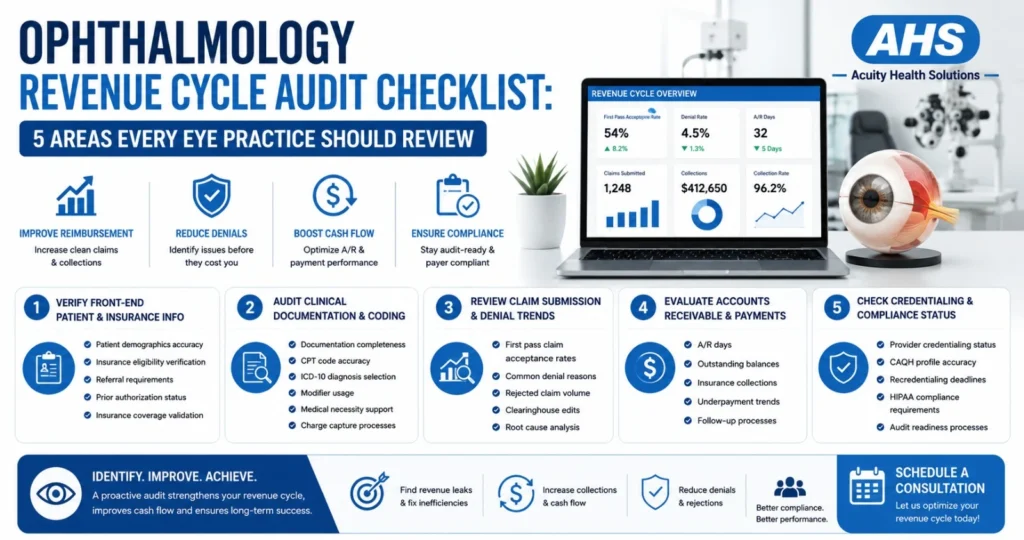
3. Review Claim Submission & Denial Trends
The first time is the best, or else. The key to a successful revenue cycle is submitting clean claims the first time. Claim performance and denial trends should be studied periodically to track practice performance.
Evaluate:
- The first pass claim acceptance rates are 54% and 45%, respectively.
- Common denial reasons
- Rejected claim volume
- Clearinghouse edits
- Root cause analysis
The frequent rejections may mean there is a problem with the workflow that needs to be addressed. Monitoring denial trends enables practices to avoid making the same mistakes and to collect claims faster.
4. Evaluate Accounts Receivable & Payment Performance
One of the best measures of the health of the revenue cycle is accounts receivable performance. There can be a huge impact on cash flow and collections if there are unpaid claims that are not followed up.
The areas around which the monitoring should be performed include:
- A/R days
- Outstanding balances
- Insurance collections
- Underpayment trends
- Follow-up processes
Learn More -: Underpayments vs Denials: How to Identify and Recover Missed Revenue
5. Check Credentialing & Compliance Status
Reimbursements can be stalled because of credentialing and compliance challenges before you’ve even gotten started with your billing. Unexpected payment disruptions are frequently caused by enrollment issues and challenges to providers.
Review:
- Provider credentialing status
- CAQH profile accuracy
- Recredentialing deadlines
- HIPAA compliance requirements
- Audit readiness processes
Learn More -: Credentialing & Enrollment Services
Learn More -: HIPAA and Revenue Cycle Operations
Why Acuity Health Solutions for Ophthalmology RCAs?
When it comes to ophthalmology Revenue Cycle Management, Acuity Health Solutions does it all. We don’t just look at denied claims; we look at the whole revenue cycle to find all the revenue leaks and inefficiencies that we can.
We audit and review workflow, billing practices, coding accuracy, denial patterns, A/R performance, credentialing status and payer issues. We offer real-world solutions that can help you improve your financial future while collaborating with your current team.
Conclusion
A proactive revenue cycle audit can identify areas of inefficiency that can impact the practice’s cash flow, compliance, patient satisfaction, and success. An analysis of front-end processes, coding accuracy, denial trends, accounts receivable performance and credentialing status can yield insights for improvement.
Whether you are seeing an increase in denials, slower reimbursements or inconsistent collections, Acuity Health Solutions can help you take a look at your revenue cycle, determine where you can make improvements, and create a more efficient billing process.