

One of the most complicated and complicated fields of outpatient billing concerns pain management coding, as it integrates procedure coding, imaging requirements, and medical necessity with payer requirements, as well as Compliance requirements. Most injections, fluoroscopy, and frequency limits may influence paying, denying or auditing a claim.
Common Pain Management Procedures and Coding Risks
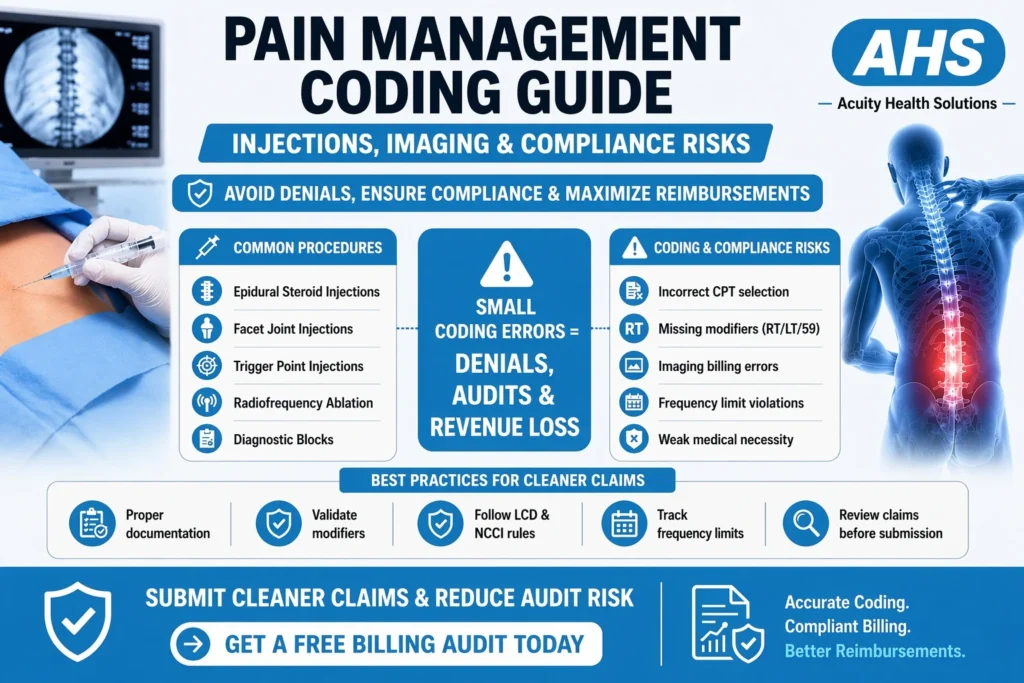
The procedures that are regularly billed by pain specialists include epidural steroid injections, facet joint injections, trigger point injections, diagnostic blocks and radiofrequency ablation. All these procedures involve various coding regulations, documentation requirements, and reimbursement in anticipation.
A valid code in one procedure might not be appropriate in another procedure when the approach, body region or the level are recorded inaccurately.
| Procedure Type | Common Coding Issue | Compliance Risk |
| Epidural steroid injections | Wrong level or approach | Denial for incorrect CPT selection |
| Facet joint injections | Missing laterality or level detail | Underpayment or rejection |
| Trigger point injections | Inadequate documentation of pain sites | Medical necessity denial |
| Radiofrequency ablation | Frequency limit issues | Audit risk |
| Diagnostic blocks | Weak proof of prior conservative care | LCD non-compliance |
Imaging and Modifier Concerns
Pain management claims can be challenging in imaging guidance. Fluoroscopy can be billed with certain other procedures, whereas ultrasound or other imaging services may be billed differently based on payer policy.
Modifiers like 26, 50, RT, LT or 59 should be cautiously applied and must be backed up by documentation. In case the operative note fails to state the necessity of imaging and the application of imaging in the procedure, the claim can be rejected.
Compliance Risks to Watch
LCDs, prior authorization rules, and frequency limits should be given special consideration in pain management practices. Medicare and commercial payers usually demand evidence of conservative treatment prior to sanctioning some injections or procedures.
Monotonous practice which is not improving or supported by clinical reasons may result in exposure to compliance. Reviews of claims should also be checked against NCCI edits, duplicate billing and errors in the modifiers prior to submission.
Compliance Red Flags in Pain Management
When documentation and coding is not in line with payer expectations, the pain management practices are at a high risk of denials and audits.
The most frequent red flags are the repetition of injections without evidence of clinical change, lack of conservative treatment history, misuse of Modifiers, billing imaging that is included in the procedure.
Even minor mistakes may result in underpayment or post-payment checks. Epidural steroid injections, facet procedures, and other interventional services should also be careful of limit frequency of practice. These issues can be spotted with the help of a robust internal review process.
Key points :
- Unimproved repeated procedures.
- Absent conservative history of therapy.
- Improper or incorrect use of modifiers.
- Billing was billed separately in imaging.
- Bypassing the frequency limits to payers.
- Poor medical necessity records.
- Poor coding of diagnosis and procedures.
- Lack of internal claim review before submission.
Compliance risk can be minimized through regular audits, clear physician documentation and scrubbing claims to increase the accuracy of reimbursement. Prevention is always the best medicine in pain management as it is always easier to prevent rather than cure a rejected or reimbursed claim once payment has been made.
Best Practices for Cleaner Claims :
- Consider payer policies when planning the procedure.
- Clear documentation of pain location, severity, history of treatment and response.
- Determine whether imaging is included or not.
- Always use modifiers where justified by the record.
- Keep track of frequency limits and repeat procedure patterns.
- Certify LCD and NCCI compliance and send claims.
Conclusion
Medical Billing related to pain management is much more precise when the code, documentation, and compliance are all done at the same time. Close attention is paid to injections, imaging coordination, and frequency rules since a single omitted detail may lead to denial or audit risk. Those practices that conduct review, document the medical necessity, and ensure that modifiers are verified in advance are in better positions to defend revenue.
A strict billing procedure is not only beneficial in terms of better collections, but also enhances adherence to all processes. The purpose of this is simple: to present cleaner claims, minimize unnecessary mistakes, and maintain reimbursement in line with the care delivered to the patient by the pain professionals.