

The Hidden Cost You’re Not Tracking
In the USA, without even knowing it, many oculoplastic practices are losing 15–25% of their income to billing inefficiencies. High-value procedures, like eyelid surgeries and reconstructive treatments, are susceptible to even minute errors, causing enormous financial catastrophes.
What Is Oculoplastic Billing?
Oculoplastic Billing deals with claims that are made in respect to eyelids, orbit, tear ducts, and facial reconstruction. The reason that it is complicated is that it requires both functional and cosmetic procedures that are subject to different reimbursement rules. Billing accuracy is also vital in the stability of revenue because practices have to handle insurance-based claims and self-pay patients.
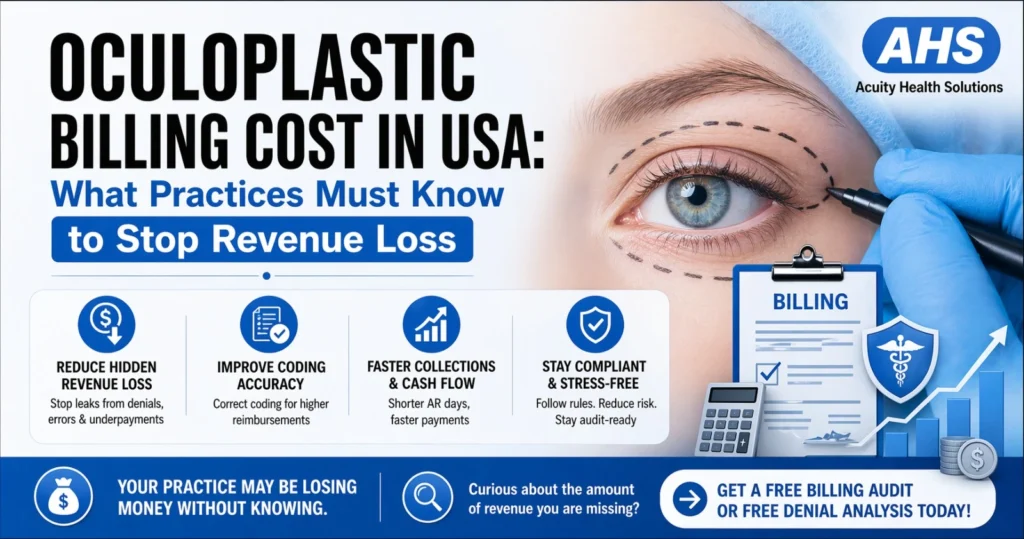
Oculoplastic Billing Cost in USA
Common Pricing Models
| Model | Description | Typical Range |
| Percentage-Based | Fee based on collections | 4%–9% |
| Flat Fee Model | Fixed monthly cost | Varies |
| Hybrid Model | Mix of flat + percentage | Custom |
Factors Affecting Cost
- Volume and patient load.
- Difficulty of oculoplastic procedures.
- Insurance vs self-pay ratio
- In-house/Outsourced billing set up.
The appropriate model will be based on your practice size and financial objectives.
In-House vs Outsourced Billing Cost Comparison
In-House Billing Costs
- Salaries and benefits of employees.
- Ongoing training and upgrading.
- Invoicing programs and applications.
- Increased errors and refusals.
Outsourced Billing Benefits
- Predictable and scalable cost
- Reduced administrative overhead
- Availability of the expertise.
- Increased compliance and accuracy.
In-house billing has hidden costs that are not easily realized but have a great effect on profitability.
Hidden Revenue Loss in Oculoplastic Billing
Most of the practices are not even aware of the money they are losing.
Common issues include:
- Insurance underpayments.
- Coding errors that result in decreased reimbursements.
- Unbilled procedures.
- Poor denial management
Research indicates that clinics end up losing 10-20% of revenue because of these loopholes- without even realizing it.
ROI of Outsourcing Billing Services
Outsourcing oculoplastic Medical Billing is not a cost alone-it is an investment.
Revenue Increase
- Fewer rejections because of the correct submission of claims.
- Improved coding precision
Faster Collections
- Decreased Accounts Receivable (AR) days.
- Quicker payment cycles
Operational Efficiency
- Employees are able to pay attention to patient care.
- Reduced administrative burden
Typical Results:
- 10–25% revenue improvement
- 20–40% reduction in denials
Simple ROI Example
Breaking it down, we will have:
- Monthly practice revenue: $100,000
- Billing cost (6%): $6,000
- Revenue improvement (15%): $15,000
Net gain: $9,000/month
This is a clear indication that outsourcing can lead to a direct profitability increment.
When Should You Outsource Billing?
Consider outsourcing if you notice:
- Low claim acceptance rates.
- Delayed reimbursements
- Employees with billing challenges.
These are good indicators that your Revenue Cycle Management should be optimized.
How to Choose the Right Billing Company
The process of selecting an appropriate Medical Billing Company in USA.
Prior to choosing a partner, examine:
- Experience in oculoplastic billing
- Open pricing and reporting.
- Good adherence to the US healthcare laws.
- Established history in the reduction of denial.
Finding the appropriate partner guarantees financial stability in the long run.
Conclusion
Oculoplastic is a complicated billing procedure, and ineffectiveness may quietly rob you of your substantial profit. Knowledge of cost structures, finding the invisible losses, and the correct use of billing are crucial to financial stability.
Subcontracting to a dedicated billing partner not only minimizes errors but also enhances the collections and effectiveness. With patient care and constant growth and profitability in your practice, you are able to optimize your revenue cycle and, at the same time, concentrate on patient care.