

Proper usage of modifiers is important to clean claims filing and revenue integrity. Some of the most examined CPT modifiers are Modifier 25, Modifier 59, and the X modifiers (XE, XS, XP, XU). These modifiers embrace after-legitimate reimbursement as long as they are used with proper support. They often result in denials, audits, and recoupment by the payers when abused.
Knowledge of when to apply them, and otherwise, is the key to keeping the compliance.
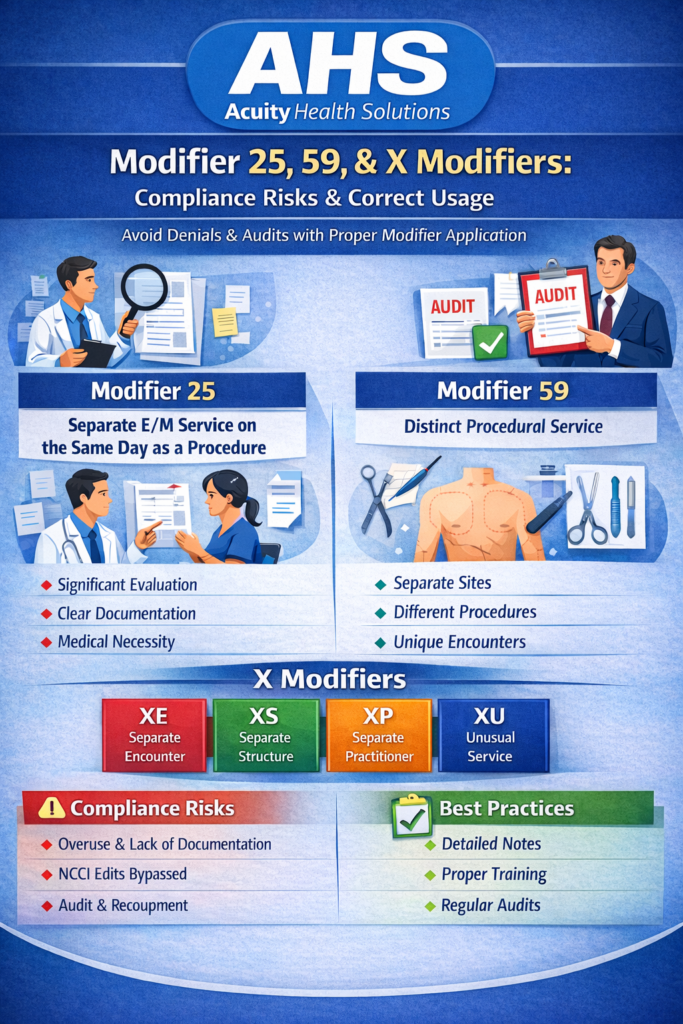
Modifier 25: Significant, Separately Identifiable E/M Service
Modifier 25 is added to an Evaluation and management (E/M) code whenever a material and separately identifiable E/M service is rendered on the same day as a procedure.
Correct usage requires:
- Medications prove that extra clinical work was performed on top of the procedure.
- Knowingly, an E/M Medical Billing Service that is not routine pre- or post-procedure patient care is medically necessary.
- Effective provider notes in favor of distinct decision-making.
Common compliance risks:
- Appendix Modifier 25 to all procedure visits automatically.
- Applying it in situations where little evaluation has been done.
- There is a lack of necessary documentation to support the separate E/M.
Modifier 25 is highly abused, and as such, payers are careful when considering it. The claims are bound to be refused or recovered without any solid clinical support.
Modifier 59: Distinct Procedural Service
Modifier 59- refers to the fact that two different services that should have been done in one package as they traditionally were, were done in different services owing to reasons including;
- Different anatomical sites
- Separate encounters
- Different incisions or lesions
It is to be employed only in cases when there is no other specific modifier.
Common compliance risks
Since it is not necessary to use it in order to replace the National Correct Coding Initiative (NCCI) edits.
Implementing it without reporting the reasons why the procedures are different.
Their approach is to take it as a bypass modifier rather than a Clinical Coding indicator.
The most frequent reasons for post-payment audits are improper usage of the Modifier 59.
X Modifiers: A More Precise Alternative to Modifier 59
Purchasers are moving more towards the X modifiers instead of the Modifier 59:
- XE – Separate encounter
- XS – Separate structure
- XP – Separate practitioner
- XU – Unusual non-overlapping service
These modifiers communicate why services are distinct, reducing ambiguity and strengthening claims defensibility.
Best practice:
Enter an X modifier where possible instead of Modifier 59. The use of X modifiers has gained a lot of favor with many payers to ensure enhanced adjudication.
Documentation: The Foundation of Modifier Compliance
No modifier stands alone. All claims need to be backed by documentation, which will clearly explain:
- Medical necessity
- Distinct services provided
- Clinical rationale for separation
- Provider decision-making
Templates, copy-paste notes, or general statements are of great audit exposure.
Practical Tips to Reduce Modifier-Related Denials
- Train companies on what makes a separately identifiable service.
- Conduct periodic internal audits of the use of Modifier 25, 59, and X.
- Adjustments made by NCCI prior to claims.
- It will demand extensive provider documentation of same-day E/M and procedures.
Why This Matters
The misuse of the modifiers does not mean only that the payment will be delayed, but that there will be compliance risk. The recurrence of mistakes may result in payer investigations, requirement of paybacks, and credentialing problems in the long run.
This is a systematic approach to the moderation of income and reputation.
Final Thoughts
The X modifiers, the modifier 25, and the modifier 59 are very effective tools of billing, as long as they are applied properly. These, however, require clinical accuracy, good documentation, and regular monitoring.
The educational, auditing, and process control practices reduce the incidence of denials by a large margin while being in line with the standards of payer compliance.
Acuity Health Solutions is a provider that assists healthcare organizations to enhance the quality of their coding, lower audit risk, and establish an efficient method of reimbursement through disciplined management of the revenue cycle .