

The financial health of dermatology Medical Billing Practices can be seriously impacted if days in A/R (accounts receivable) are high. Slow collections, increasing operating costs, payer complexity and payment delays due to denials all impact cash flow. Procedural coding, using modifiers, the difference between cosmetic and medical claims, and billing requirements by payers are other billing challenges dermatology clinics experience.
Claims that are not settled for extended periods cause stress to practices, loss of revenue and profitability. To enhance reimbursement efficiency and minimize AR aging, more providers are turning to specialized dermatology Medical Billing Services today.
Understanding of the Accounts Receivable (AR) Days
AR days track the amount of time it takes a healthcare practice to receive payment after the service. The fewer the AR days, it means that the invoicing process is, and reimbursements come in faster to have a more positive cash flow.
High AR days could indicate:
- Billing inefficiencies
- Claim denials
- Delayed payer processing
- Weak follow-up workflows
- Incomplete documentation
As a dermatology practice, AR performance can impact the growth and revenue of your business, so it is essential to measure this aspect of your operations. Because even a single day’s delay in billing can affect the revenue and growth of your business, tracking AR performance is critical for dermatology practices.
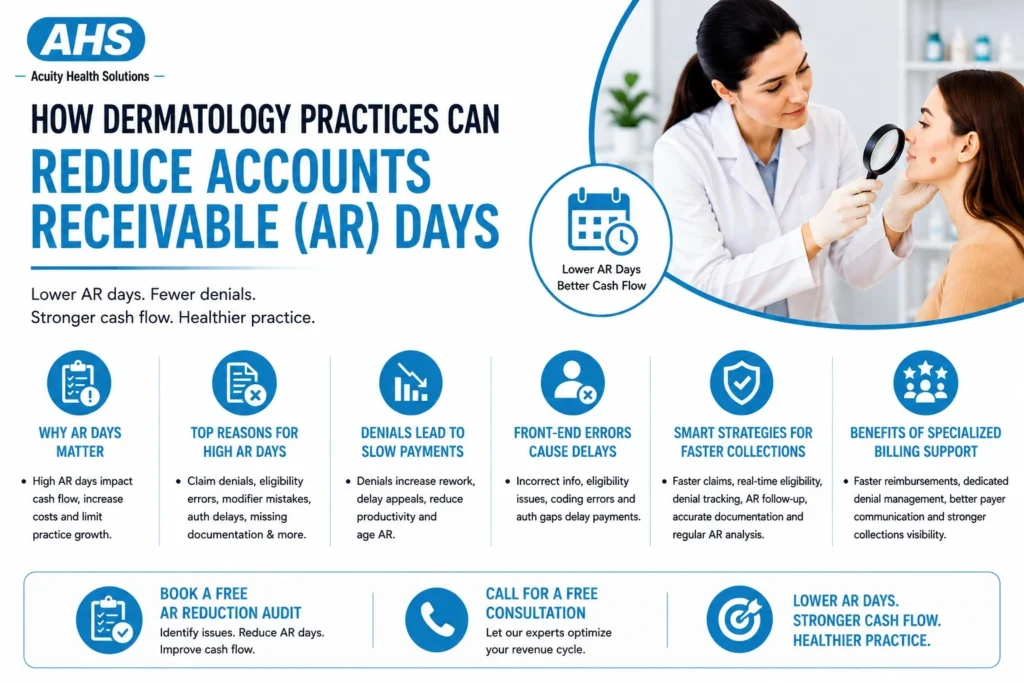
The Reason Behind Slow Collections In Dermatology Practices
The reasons for aging bucket include too many billing complexities preventing insurance company payouts.
Here are some of the reasons why we see high AR days, as mentioned below:
- Claim denials
- Eligibility verification errors
- Modifier usage mistakes
- Prior authorization delays
- Missing documentation
- Delayed claim submission
- Weak denial follow-up
- Underpayment issues
Given the medical and cosmetic domain of dermatology services, coding precision is extremely essential to avoid hiccups in receiving payments, leading to revenue loss by billing teams. Inconsistent workflows can lead to bottlenecks and revenue leakage in reimbursements.
Claim denial reduction practices can also frequently improve collections and speed up reimbursements.
The Connection Between Denials and Slow Payments
One of the most significant drivers of the increase in AR days for dermatology billing is Claim Denials. It takes extra staff time to correct denied claims, appeal the claims, resubmit claims, and follow up with the payer when a claim is denied.
Denials increase:
- Rework time
- Appeals processing delays
- Staff productivity loss
- Insurance review timelines
- AR aging
The most frequent denials that dermatology practices face are related to differences in cosmetic billings, challenges to medical necessity, incomplete documentation, and modifier problems. The potential denials received, no matter how small the charge, can have a significant impact on monthly collections and cash flow.
By embracing medical billing best practices to decrease the claim denial rates, practices can enhance their overall performance related to billing.
How Front-End Errors Lead to Higher AR Days
A lot of reimbursement delays start in the process of submitting claims. Front-End Billing Errors can lead to claim denials, delayed approvals and more denials.
Typical front-end issues that arise are:
- Incorrect patient information
- Insurance eligibility errors
- Authorization gaps
- Coding inaccuracies
- Charge capture delays
Consistent front-end workflows can help speed claims approval and increase collections uniformity. One of the major components of optimising the front-end revenue cycle is optimising patient intake and eligibility checks.
How Dermatology Practices Can Improve Collections Faster
The key areas of efficiency, denial management and proactive billing control all play a part in reducing AR days.
Some of the more effective strategies for achieving AR reduction are:
- Faster claim submission
- Real-time eligibility verification
- Strong denial tracking
- Regular AR follow-up
- Accurate documentation workflows
- Speciality-focused coding reviews
- Payer trend monitoring
- AR aging analysis
Regularly tracking billing performance is more likely to lead to better billing performance and quicker reimbursement.
Benefits of Specialized Dermatology Billing Support
Outsourcing dermatology billing services improves the speed of getting paid and reduces the administrative burden for the medical practice.
Specialized billing support offers:
- Faster reimbursement follow-up
- Dedicated denial management
- Better payer communication
- Enhanced reporting and analytics.
- Stronger collections visibility
- Reduced operational workload
Billing teams with an A+ type of billing mix may also see faster claim turnaround times and denial recovery rates from their existing billing expertise and more specialized workflows.
Looking for tips to cut AR Days in your Dermatology Practice?
Learn about the specialized dermatology billing support that can enhance your revenue cycle and provide better collections and payment on time.