

In the USA, Dermatology Practices are dealing with administrative expenses, more complex administrative payers, and escalating denial management issues. A lot of clinic owners and administrators are reviewing their billing processes in 2026 to see how effective they are.
Billing is no longer an operational cost, but a direct cost to collections, cash flow and profits today. With this growing trend, companies are looking to compare the cost of billing in-house with the cost of billing their products out of house, in order to streamline and reduce revenue leakage.
Working with Medical Billing Services specializing in dermatology can help medical practices optimize billing processes and enhance reimbursement rates.
Common Dermatology Billing Pricing Models
There are three kinds of dermatology billing companies, and they are generally priced according to one of these.
Percentage-Based Pricing
This is the most common one, where the billing company takes a fee as a percentage of the amount collected. It is scalable and incentive aligned since the billing provider is successful if collections are increased.
Flat Monthly Fee
Other companies require a monthly fee. This provides more straightforward costs and can be effective for more consistent practices with a steady stream of claims.
Hybrid Pricing Model
A tiered pricing model, with flat fees, percentage fees and services like coding audits or denial management.
Typically, the costs of a product are determined by:
- Claim volume
- Provider count
- Denial rates
- Specialty complexity
- Included services
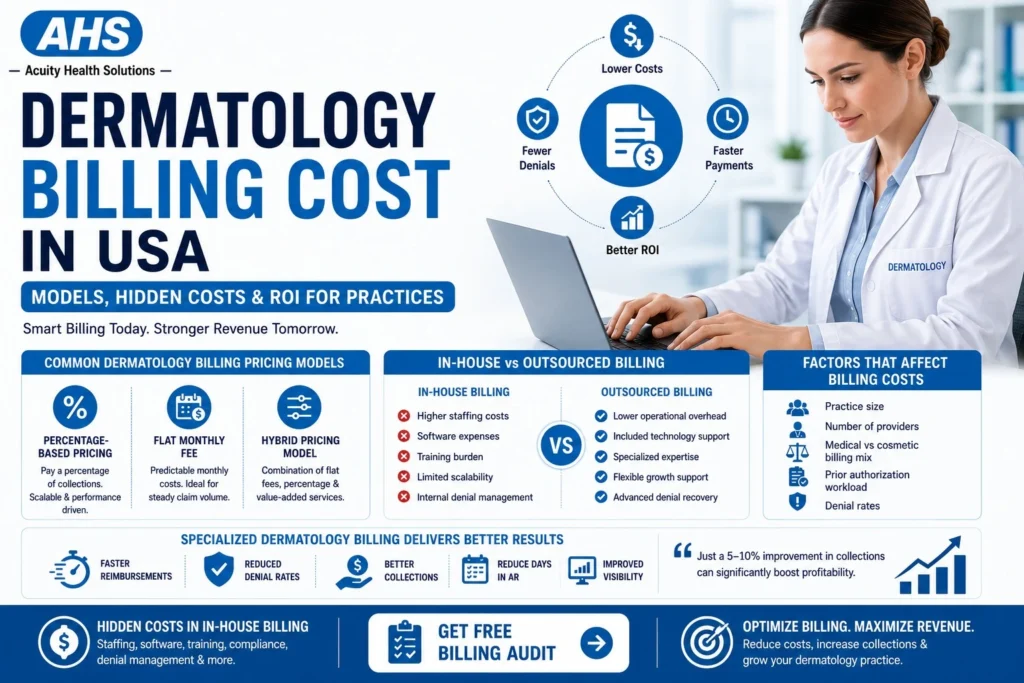
What Factors Affect Dermatology Billing Costs?
There are several factors that affect the dermatology billing cost:
- Practice size
- Number of providers
- Medical vs cosmetic billing mix
- Prior authorization workload
Which Billing Model Is More Cost Effective?
| In-House Billing | Outsourced Billing |
| Higher staffing costs | Lower operational overhead |
| Software expenses | Included technology support |
| Training burden | Specialized expertise |
| Limited scalability | Flexible growth support |
| Internal denial management | Advanced denial recovery |
Understand How Outsourced Dermatology Billing Pricing works
Typically, outsourced billing companies will charge a percentage rate and will usually have the following services as part of their cost:
- Coding support
- Eligibility verification
- Claim submission
- Payment posting
- Denial management
- Reporting and analytics
Outsourcing Medical Billing can help decrease the strain on staffing, technology investment, and billing inefficiencies and also help to speed up reimbursement and collections.
Practices also benefit from practices that are scalable, without adding extra in-house personnel.
How Specialized Billing Can Improve Practice Revenue
By utilizing specific dermatology billing support, you can enhance your financial performance by means of:
- Faster reimbursements
- Reduced denial rates
- Better collections
- Reduce days in AR
- Improved operational visibility
Just a 5-10% improvement in collections can have a substantial impact on billing costs and profitability.
Understanding the Relationship between Billing Costs and Revenue Performance
The billing price range for dermatology practices can differ significantly based on a variety of factors, including practice complexity, claim volume, and the structure of the practice. In-house billing is often costlier, though, due to hidden administrative costs.
Custom billing assistance can help maximize collections, minimize denials, and boost operational efficiency. Billing optimization today is more of a growth and operational plan than a financial plan in this competitive healthcare industry.
Wishing you a better Dermatology Billings Performance?
Learn how specialized dermatology billing support can minimize denials, maximize collections and enhance RCM performance.