Urgent care centers are high-volume, and billing requirements can be complicated. Accurate E/M leveling with “bullet-proof” documentation and proactive denial management distinguishes thriving practices from cash-strapped lifestyles.
Focusing on these three pillars can drive 15-25% improvement in collections and reduce administrative headaches. Here’s the comprehensive guide to urgent care billing best practices.
Understanding E/M Leveling in Urgent Care
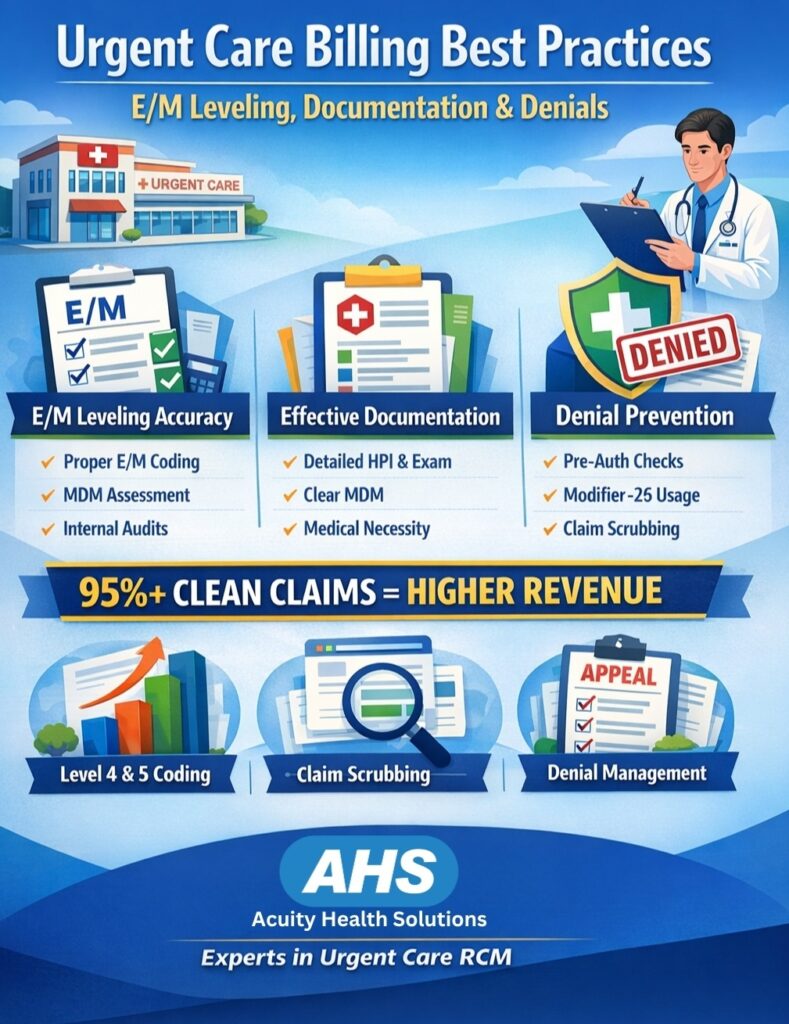
Evaluation and Management (E/M) coding plays a central role in urgent care billing. Each patient visit must be assigned the correct E/M level based on medical decision-making (MDM) or total time spent.
Common challenges include:
- Overcoding as a Result of Misassessing Complexity
- Undercoding, leading to revenue loss
- Misinterpretation of MDM elements
To improve accuracy:
- Ensure providers are educated on the new E/M guidelines
- According to the 2021 E/M changes, use standardized templates
- Conduct regular internal audits
Proper E/M leveling leads to compliance with maximal income.
E/M Leveling: The Revenue Foundation
Urgent care E/M distribution typically breaks down:
- Level 3 (99283): 45-55% of visits (laceration repair, simple fractures)
- Level 4 (99284): 35-45% (moderate MDM, chest pain workups)
- Level 5 (99285): 5-15% (high-risk, sepsis workups)
Common Mistakes to Avoid –
Code Level 4 visits at level 3. Higher levels after MDM documentation typically justify higher because we bill based on time (30-40 min for 99284).
Documentation: Your Legal & Financial Shield
Urgent care documentation must demonstrate medical necessity for every code billed:
History (HPI) Best Practices:
- 7+ elements for comprehensive HPI (location, quality, severity, duration, timing, context, modifying factors)
- Associated signs/symptoms justify a higher MDM
- “Patient states chest pain x2hrs” ≠ “Pt reports substernal chest pressure 2hrs, 7/10, radiating to jaw, worse with exertion”
MDM Documentation Framework:
- 2+ chronic conditions (HTN, DM, COPD)
- New problem (URI → pneumonia workup)
- Data ordered (ECG, labs, imaging)
- Risk (prescription strength, urgent referral)
Top Urgent Care Denials & Prevention
80% of urgent care denials fall into 3 categories:
| Denial Code | Issue | Fix |
| CO-16 | Missing auth | Real-time eligibility verification |
| CO-97 | Bundled service | Separate E/M from procedures |
| PR-96 | Non-covered | Urgent care designation on claims |
Proactive Prevention Checklist:
- Pre-verification for all commercial payers
- Modifier -25 on E/M + procedure same day
- Place of Service 20 (urgent care) always
- 261QU0200X — taxonomy of urgent care)
Billing Workflow Optimization
1. Charge Capture (Day 0)
- Superbill reconciliation before shift end
- E/M calculator apps (MDCalc, QPP)
- Doing a review of daily charges from the billing lead
2. Claim Scrubbing (Day 1-2)
- 99% clean claim target
- Automated auth tracking
- Payer-specific rules engine
3. Denial Management (Day 30+)
- Weekly aging report (process work 30–60 days first)
- Appeal templates by denial code
- Tracking root cause (coding vs auth vs coverage)
The Role of Strong Clinical Documentation
Urgent care billing is built upon documentation. Even claims with correct codes may be denied without adequate and accurate records.
Key factors of effective documentation:
- Chief complaint and relevant history
- Detailed examination results
- Clear medical decision-making (MDM)
- Diagnosis connected to treatment provided
No generic or cloned notes. Instead, documentation needs to capture the individuality of each patient visit.
Best practices include:
- Live documentation during or shortly following visits
- Structured templates that allow individuality
- Maintaining accuracy between notes and ordered codes
Good documentation is an enabler for claims and also safeguards against audits and compliance risks.
Bottom Line
Send your E/M-leveling practices to the next level + Implement proper bullet-point documentation + Significantly reduce your future denials = 95%+ clean claims/30-day A/R; Urgent care practices that are using these methods are reporting better than an 18-22% revenue growth within just 90 days of implementation.
Need urgent care billing expertise? Acuity Health Solutions — 98% clean claim rates with over 50 centers across doorsteps nation-wide, specializing in high-volume urgent care RCM.