
The safety of patient data is as vital in the recent healthcare setting as proper billing. The Health Insurance Portability and Accountability Act (HIPAA) imposes rigorous requirements for patient information protection in all Revenue Cycle activities. Nonetheless, most health institutions engage in violating HIPAA rules without knowing about them in the process of making bills, which brings in monetary fines, audits, and negative publicity.
It is imperative to know the typical HIPAA breaches involving billing to ensure compliance and the quest to attain improved outcomes in terms of the revenue cycle.
Why HIPAA Compliance Matters in Medical Billing
Revenue Cycle Management processes are linked to processing delicate patient information at each step, including registration and eligibility checks, all the way up to submitting claims and recording payments. Protected Health Information (PHI) can be exposed through any failure in data protection, and this leads to compliance risks.
HIPAA compliance ensures:
- Confidentiality of the patient.
- Intrusion-free data transfer and storage.
- Less penetration by penalties and lawsuits.
- Relief between patients and providers.
To achieve compliance across the revenue cycle, strict rules have to be observed by Medical Billing teams.
Common HIPAA Violations in Billing Operations
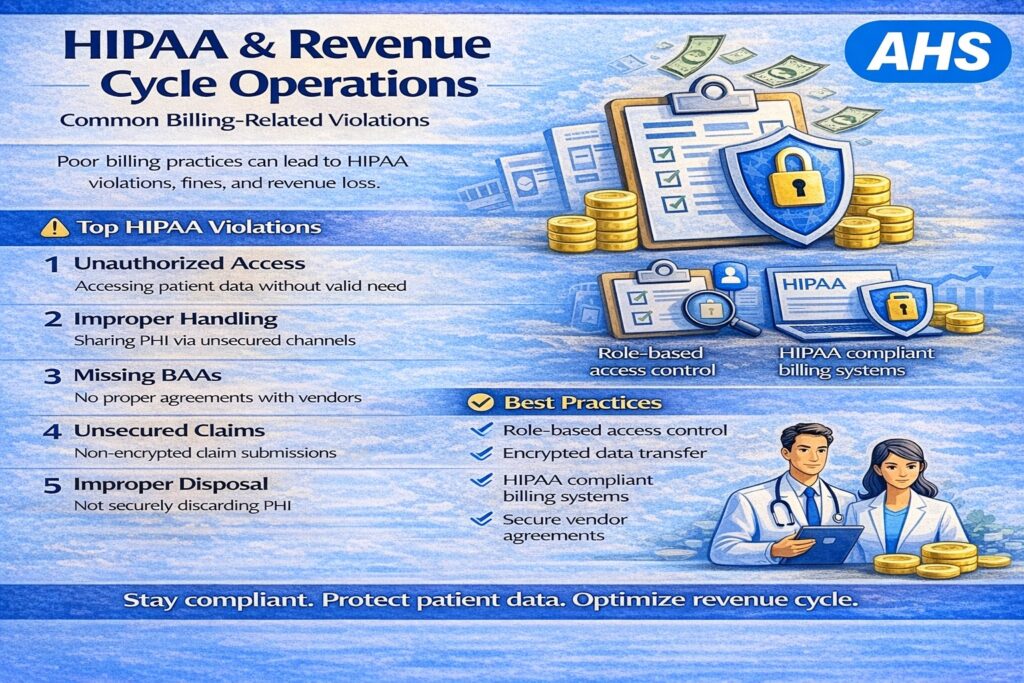
1. Unauthorized Access to Patient Data
Illegally accessing patient records when one does not have a valid justification is one of the most common breaches. Medical Billing staff should only grab PHI as is pertinent to them.
2. Improper Handling of Patient Information
Sending information that is not secured (via personal email account or messaging applications) is a grave breach of patient information.
Any communication of billing should be conducted using secure and HIPAA-compliant platforms.
3. Incomplete Business Associate Agreements (BAAs)
The HIPAA regards third-party billing companies and clearinghouses as business partners. The inability to set up the right BAAs may lead to compliance breaches.
All external vendors who deal with billing should enter into a valid agreement with the responsibilities of data protection.
4. Unsecured Electronic Claim Transmission
The lack of encryption or the use of nonconforming systems to submit claims subjects patient data to transmission.
Electronic Data Interchange (EDI) systems should also be safe and meet the HIPAA requirements.
5. Improper Disposal of PHI
Billing forms, EOBs, and patient records should be safely disposed of. Sending documents into the general garbage without shredding or destroying electronic data can result in data theft.
Impact of HIPAA Violations on Revenue Cycle
Compliance dilemmas are not the only consequences of HIPAA violations, but have a direct financial performance effect.
Consequences include:
- Heavy financial penalties and fines
- Increased audit risk
- Delayed claim processing and reimbursements
- Loss of patient trust
- Operational disruptions
Lack of compliance can altogether make revenue cycle operations slow-paced and cause long-term financial losses.
Best Practices to Ensure HIPAA Compliance in Billing
To avoid violations and strengthen compliance, Healthcare organizations should implement:
- Billing team role-based access control.
- Encrypted flow of information.
- EDI systems and hippa compliant billing software.
- Frequent employee training and audit of compliance.
- Effective recording and vendor contracts (BAAs).
- Effective password control and multi-factor authentication.
These are measures that can be used to protect patient data or even have a smooth and compliant billing workflow.
Why Partnering with a Compliance-Focused RCM Provider Matters
HIPAA compliance and billing are two operations that may be difficult to manage.
By collaborating with an established revenue cycle management company, it will guarantee:
- Protective management of patient information.
- HIPAA and payer compliance.
- Fewer risks of violations and audits.
- Good and effective billing procedures.
A compliance-based strategy not only covers your organization but also enhances the efficiency of your revenue cycle in general.
Final Thoughts
HIPAA compliance is not a regulatory mandate; it is an important part of effective revenue cycle management. Violations about the billing are common because there is a small divergence in the processes, training, or because of old systems.
Recent occurrences of risks can usually be identified, and the proper compliance practices can ensure that the Healthcare Organizations safeguard patient data, avoid penalties, and ensure that the revenue cycle balance and run effectively.
To avoid possible issues regarding data security, in modern times of growing awareness of data safety and security, the paralleling of billing functions to HIPAA standards is key to not only its compliance but also its success over the long term.