
In the modern day and the landscape of reimbursement, the term clinical documentation has ceased to be a medical record; it is legal evidence of medical necessity. In the case of documentation that does not corroborate the services that have been billed, payers are allowed to deny claims, to audit, and even to seek recoupments many months or years later.
To the Healthcare Providers, insufficient documentation is one of the most widespread catalysts of payer scrutiny. It is imperative to learn how documentation gaps contribute to audits and how to avoid them in order to secure the revenue.
Why Documentation Matters in Reimbursement
Every billed service must meet three standards:
- Medical necessity
- Accurate coding alignment
- Sufficient clinical detail
Payers such as Medicare, Medicaid, and commercial insurers are examining documentation in order to ascertain whether services to patients were necessary and reasonable. In case notes fail to provide a clear explanation of either the diagnosis or treatment decision or the level of service, the claim is prone to rejection or subsequent review of payment.
This needs to be documented independently. Coders do not have a free hand to assume intent, and auditors are not allowed to learn about it using verbal clarification afterwards
Common Documentation Deficiencies That Trigger Audits
Insufficient Medical Necessity
The use of statements like follow-up visit or routine check is not likely to meet payer requirements. Notes should say the reasons why the service was needed and how this service influenced clinical management.
Mismatch Between Diagnosis and Procedure
Where the ICD-10 diagnosis is not in support of the CPT service that has been performed, the auditor might consider the claim as unsupported, although care might have been appropriate.
Missing Time Documentation
In time-sensitive services like psychotherapy, critical care or extended E/M visits, precise initiations and terminations of time are frequently needed. Adjustments are liable to downcoding or recoupment in case of failure to make time documentation.
Cloned or Template Notes
Documentations that have been copied and pasted during auditing attract red flags. Use of the same words in many encounters could mean that services were not customized.
Missing Signatures or Late Entries
Uncleared notes or unfixed amendment records undermine legal defensibility in the course of audit review.
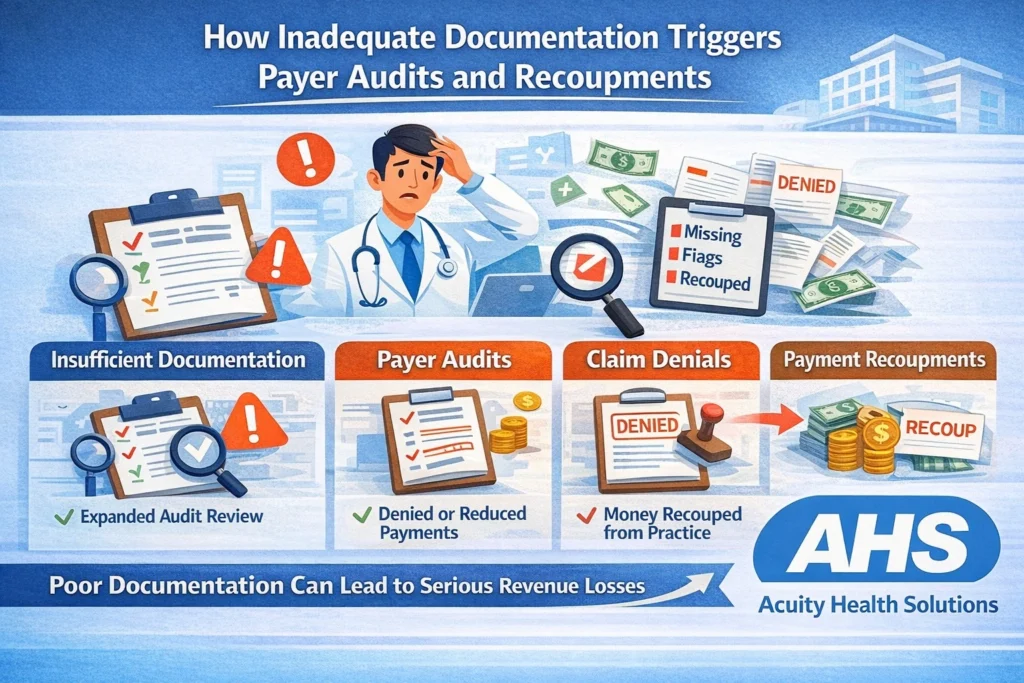
How Audits Escalate to Recoupments
Audits can start out as regular after-payment auditing.
In case billed services are not supported by documentation, payers can:
- Request money back for already paid claims.
- Expand the audit sample size.
- Carry out extrapolated overpayments.
- Send cases to additional research.
Reviews of large sample sizes may also be subject to recoupment and thus have considerable effects on practice cash flow.
The Financial Impact on Practices
Documentation mistakes are a source of operational stress even in the absence of any fraud:
- Increased administrative burden
- Delayed payments
- Legal consultation costs
- Reputational risk
Documentation lapses, even small ones, when engaged in a pattern in several cases, will mount into massive financial risk.
Preventing Documentation-Related Audit Risk
To minimize audit vulnerability, it is necessary to conduct systematic efforts:
- Frequent internal documentation audit.
- Education of the providers on the medical necessity standards.
- Coders and clinicians are aligned.
- High-risk service pre-bill documentation review is real-time.
- Observing the trend of payer audits.
It is a lot more expensive to react to a post-payment recoupment demand than proactive review.
How Acuity Health Solutions Strengthens Documentation Integrity
Acuity Health Solutions helps providers to support the revenue cycle by incorporating documentation review into the cycle. Instead of the correctness in coding, Acuity analyzes the ability to support billed services through clinical notes.
With focused audits, compliance controls, and denial trend analysis, practices can acquire a view of documentation risks early, before it becomes a subject of payer action.
This is a prevention-related approach that enhances financial predictability, minimizing audit exposure at the same time.
Final Thoughts
One of the most avoidable reasons for the payer audit and recoupments is poor documentation. Complete and medically justified notes are effective not only in safeguarding reimbursement, but also in compliance standing.
Revenue Protection is a documentation in the current healthcare world, with its emphasis on audit. The documentation integrity practices lower the risk, enhance payer confidence, and protect the long-term fiscal soundness.