
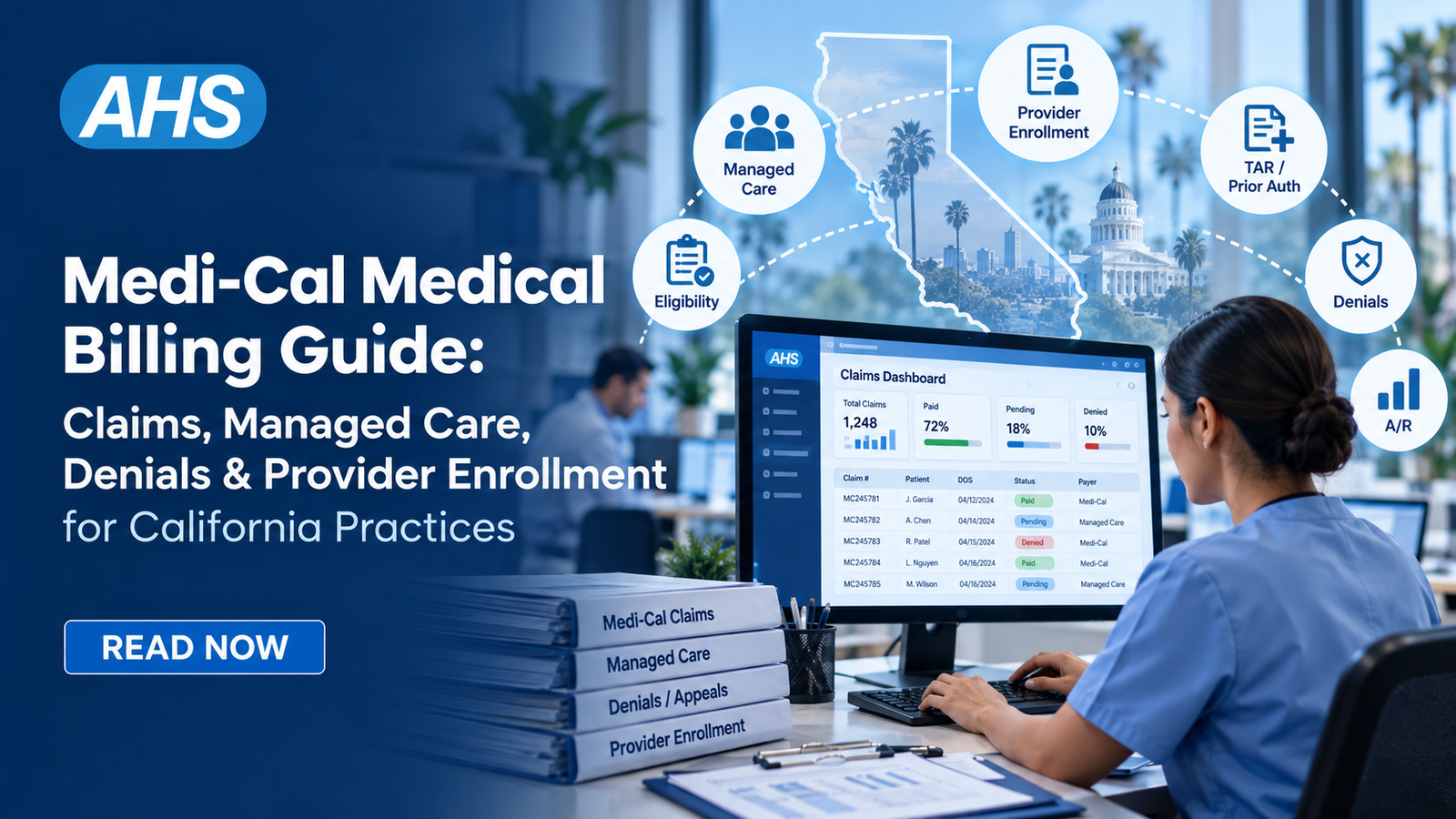
Medi-Cal medical billing is not just “California Medicaid billing.” A California practice may be dealing with fee-for-service Medi-Cal, a county-specific managed care plan, prior authorization or Treatment Authorization Request requirements, Share of Cost, dual eligibility, provider enrollment rules, and plan-specific claim submission or dispute processes—all within the same revenue cycle.
That complexity matters because many Medi-Cal payment problems begin before the claim is submitted. An inactive or mismatched provider record, incorrect plan routing, incomplete eligibility verification, a missing authorization, or the wrong ordering/referring provider information can turn a clinically valid service into avoidable rework and aging A/R.
This guide explains the practical billing issues California practices should understand in 2026, including fee-for-service versus managed care, provider enrollment, eligibility, Share of Cost, authorization, claim follow-up, denials, appeals, the upcoming ordering/referring/prescribing claim edits, and the KPIs that help reveal where Medi-Cal revenue is getting stuck. Practices looking for broader payer support can also review Acuity Health Solutions’ medical billing services in California.
What Is Medi-Cal and Why Is Billing More Complex Than a Single Medicaid Workflow?
Medi-Cal is California’s Medicaid program, but providers do not bill every Medi-Cal encounter through one identical pathway. California uses both fee-for-service and managed care delivery systems, and the correct workflow depends on the member, county, benefit, provider relationship, and service.
DHCS says Medi-Cal managed care now operates in all 58 counties through several managed care models, including County Organized Health Systems, Geographic Managed Care, Regional, Single-Plan, and Two-Plan arrangements. Providers who want to serve managed care members generally need to participate in the applicable managed care plan’s provider network. You can verify current plan options through the DHCS Medi-Cal Managed Care Health Plan Directory.
For billing teams, the practical lesson is simple: “Medi-Cal” is not enough information. Before a claim is released, staff should know whether it is fee-for-service or managed care, which plan is responsible, whether the provider is properly enrolled and contracted, and which authorization and claim rules apply.
Medi-Cal Fee-for-Service vs Managed Care: What Changes for Billing?
The distinction between fee-for-service and managed care affects where a claim goes, which rules apply, and who handles follow-up.
Fee-for-service Medi-Cal
For fee-for-service claims, enrolled providers bill through California’s Medi-Cal claims system and follow the applicable Medi-Cal provider manuals, billing instructions, authorization requirements, and claim follow-up processes. DHCS maintains current billing resources through its Medi-Cal Provider Manuals and claims-processing resources.
Medi-Cal managed care
For managed care members, the responsible Medi-Cal managed care plan becomes central to the billing workflow. Plan requirements can differ for claims submission, clearinghouses, authorization, provider disputes, reimbursement, and network rules. A practice should maintain plan-specific billing instructions rather than assuming fee-for-service rules automatically apply to every managed care claim.
This is one reason medical billing in California can become operationally demanding for multi-location or multi-specialty groups: the billing team may need different payer workflows even when the patient population is all covered through Medi-Cal.
How Does Medi-Cal Provider Enrollment Affect Claims?
Provider enrollment is a revenue-cycle issue, not just a credentialing issue. DHCS states that its Provider Enrollment Division enrolls and re-enrolls Medi-Cal fee-for-service providers, and those providers can then contract with individual Medi-Cal managed care plans to become network providers for managed care members.
That means a practice should not assume that one completed enrollment step automatically resolves every billing relationship. Enrollment with DHCS and participation with individual plans need to be tracked as connected but distinct workflows.
- Confirm each rendering provider’s Medi-Cal enrollment status.
- Keep Type 1 and Type 2 NPIs, taxonomy, ownership, licenses, service addresses, and pay-to information current.
- Track managed care plan contracting separately from state enrollment.
- Do not release claims for a new provider or location until the applicable payer records are ready.
- Build a process for revalidation, demographic changes, and provider terminations.
When enrollment and billing teams operate in separate silos, the A/R team often discovers the problem only after a denial. Acuity’s credentialing and provider enrollment services are designed to help practices coordinate these payer-facing workflows.
What Should Practices Know About the 2027 Ordering, Referring, and Prescribing Provider Claim Edits?
This is one of the most important forward-looking Medi-Cal billing issues for California practices in late 2026.
DHCS states that providers who order, refer, or prescribe for Medi-Cal members must enroll in Medi-Cal using their individual Type 1 NPI. DHCS also says new claim edits will begin rolling out in groups starting in the first quarter of 2027 across pharmacy, medical, and behavioral health claims.
The practical risk is that a billing provider may have done everything correctly on its side, but the claim can still be affected if the ordering, referring, or prescribing provider information does not meet Medi-Cal requirements once the edits are enforced.
- Identify which workflows require an ordering, referring, or prescribing provider.
- Confirm the provider is enrolled under the correct individual Type 1 NPI.
- Validate NPI data before claim submission rather than waiting for denials.
- Review referring-provider data received from outside organizations or specialists.
- Build a denial work queue specifically for enrollment-related claim edits once enforcement begins.
DHCS warns that delaying enrollment increases the risk of claim denials when the updated edits take effect. Practices should review the current DHCS Prescribers and Billing Providers FAQ as implementation progresses.
How Should a Practice Verify Medi-Cal Eligibility Before the Visit?
Eligibility verification should answer more than whether the patient has Medi-Cal. The front-end team needs enough information to identify the correct billing pathway and prevent avoidable downstream work.
- Is coverage active for the exact date of service?
- Is the patient currently fee-for-service or enrolled in a managed care plan?
- Which managed care plan is responsible?
- Is there a Share of Cost obligation that affects the encounter?
- Is another payer primary because the patient has Medicare or other health coverage?
- Does the service require authorization or another payer-specific prerequisite?
California’s Medi-Cal Learning Portal treats eligibility, Share of Cost, Treatment Authorization Requests, claim completion, and claim follow-up as separate basic billing competencies. That is a useful way to think about front-end controls: eligibility is not a checkbox; it is the start of claim routing.
Acuity’s eligibility verification best-practices guide provides a broader workflow that practices can adapt across Medi-Cal and commercial payers.
What Is Medi-Cal Share of Cost and Why Can It Create Billing Confusion?
Some Medi-Cal members have a Share of Cost requirement. Operationally, this means staff should not treat every active Medi-Cal eligibility response as financially identical.
The billing team should understand whether Share of Cost applies to the member, how it is certified, what the patient is responsible for, and how that status affects the claim. Front-desk and billing staff should use the current Medi-Cal eligibility response and official billing guidance rather than relying on a static note carried forward from a prior visit.
If Share of Cost is common in your patient population, create a written SOP that tells staff who verifies it, who explains patient responsibility, what documentation is retained, and when billing can proceed.
How Do TARs and Prior Authorization Affect Medi-Cal Claims?
Authorization is another area where fee-for-service and managed care workflows can diverge. Medi-Cal fee-for-service uses Treatment Authorization Requests for services that require approval under applicable policy, while managed care plans may use their own authorization processes.
DHCS maintains electronic TAR resources and service-specific guidance, but practices should verify the current requirement for the exact benefit, procedure, member, and payer before treatment. A prior authorization process that worked for one plan should not automatically be copied to another.
- Confirm whether authorization is required before the service.
- Match the authorization to the correct provider, location, procedure, units, and dates.
- Store the approval where billing staff can retrieve it during claim follow-up.
- Track pending authorizations before the scheduled service date.
- Do not confuse a claim appeal with an authorization appeal; they can follow different processes.
The DHCS Claims Processing page is a useful starting point for current TAR and claims resources.
What Are Common Medi-Cal Claim Denial and Rejection Problems?
There is no single denial list that applies to every Medi-Cal claim because fee-for-service and individual managed care plans can apply different adjudication rules. Still, several operational failure points show up repeatedly across Medi-Cal claims.
1. Incorrect eligibility or payer routing
The patient may have moved between fee-for-service and managed care, changed plans, or had other coverage that affects claim order. Re-check eligibility for the date of service before resubmitting.
2. Provider enrollment or network mismatch
A rendering, billing, ordering, referring, or prescribing provider record may not align with DHCS or plan data. Repeatedly resubmitting the same claim will not fix an enrollment problem.
3. Missing authorization or TAR
The service may have required prior approval, or the approval may not match what was ultimately billed.
4. Claim-data errors
Incorrect or incomplete NPI, taxonomy, diagnosis, procedure, modifier, place-of-service, units, or other claim fields can create rejections or denials. The correct fix depends on the payer message and supporting record.
5. Documentation or medical-necessity issues
When the payer requests clinical support, the billing team should know where the documentation lives, who reviews it, and how the response is submitted before the applicable deadline.
6. Timely filing or follow-up failures
Fee-for-service and managed care workflows can have different claim and dispute deadlines. Staff should verify the current rule for the applicable claim instead of relying on one global “Medi-Cal timely filing” assumption.
7. Duplicate resubmission instead of proper follow-up
Submitting the same claim repeatedly can create additional confusion. First determine whether the claim needs correction, a claim inquiry, an appeal, or a managed care provider dispute.
For a broader root-cause approach, see Acuity’s claim denial reduction services and denial management playbook.
How Should California Practices Handle Medi-Cal Claim Follow-Up?
A good follow-up workflow starts by separating claims into the right pathway. Not every unpaid claim is a denial, and not every denial should be appealed.
- Confirm claim receipt and status. Determine whether the claim was accepted, rejected, suspended, denied, or partially paid.
- Read the payer message. Identify the specific reason before changing claim data.
- Compare the claim with the medical record, authorization, eligibility, and enrollment data.
- Correct factual billing errors when appropriate. Document exactly what changed.
- Use the correct inquiry, appeal, or provider-dispute pathway when the original claim is supportable.
- Track the next action and deadline. “Called payer” is not a complete claim note.
- Feed recurring issues back upstream. If 40 claims are failing for the same reason, the solution belongs in the workflow that created the error.
DHCS maintains provider complaint resources that distinguish fee-for-service and managed care dispute pathways. Practices should use the current DHCS manuals and the applicable managed care plan’s provider-dispute process rather than treating all Medi-Cal appeals as the same.
How Do Medi-Cal Managed Care Plans Change Claim and Dispute Workflows?
Medi-Cal managed care deserves its own SOP because plan rules can differ by county and contract. DHCS notes that California’s managed care system uses multiple models and that providers serving managed care members participate through plan networks.
At minimum, your payer matrix should identify:
- The Medi-Cal managed care plan available in each county you serve.
- Your network and contract status.
- Electronic claim submission and clearinghouse requirements.
- Authorization portals and contact channels.
- Claim-status and remittance resources.
- Provider-dispute and appeal processes.
- Timely filing, reconsideration, and dispute deadlines.
California’s managed care rules continue to change. DHCS publishes current operational guidance through Managed Care All Plan Letters, including 2026 guidance on provider dispute resolution. Practices do not need to read every policy letter themselves, but someone in the revenue cycle should own monitoring for changes that affect billing.
What Should Practices Know About Medicare-Medi-Cal Dual Eligibility?
Patients who have both Medicare and Medi-Cal create another billing path. In many cases Medicare is primary, and the practice needs to understand crossover or secondary billing rules rather than treating the visit as a standard Medi-Cal-only encounter.
California is also expanding integrated Medi-Medi Plans. DHCS says Medi-Medi Plans combine Medicare and Medi-Cal benefits, and in 2026 they are open for enrollment in most California counties. This makes current eligibility and plan identification increasingly important for practices serving dual-eligible patients.
Do not build billing rules around a patient’s historical plan alone. Verify current coverage and identify whether the patient is in traditional Medicare plus Medi-Cal, a Medi-Medi Plan, or another applicable arrangement before deciding where the claim goes.
How Can California Practices Reduce Medi-Cal A/R?
Reducing Medi-Cal A/R usually requires more than assigning additional staff to old balances. The better strategy is to identify which type of problem is creating the aging.
- Segment by delivery system: separate fee-for-service from managed care A/R.
- Segment by plan: identify whether one managed care plan is driving disproportionate aging.
- Separate enrollment holds: do not bury credentialing problems inside generic denial queues.
- Track authorization-related balances: determine whether the issue is missing approval, mismatched approval, or documentation.
- Prioritize by deadline and value: high-dollar claims matter, but so do claims approaching filing or dispute limits.
- Document next actions: every account should have a clear owner, last action, payer response, and next follow-up date.
- Escalate payer patterns: a large cluster of identical denials should trigger a workflow review, not 50 isolated corrections.
For a broader receivables framework, see Acuity’s medical billing A/R management guide.
What Should California Primary Care Practices Know About Medi-Cal Billing?
Primary care practices often experience Medi-Cal billing at scale. A small inconsistency in eligibility, Share of Cost, provider enrollment, referral handling, E/M documentation, preventive-service coding, or managed care routing can repeat across hundreds of encounters.
The most useful controls for primary care are usually operational:
- Verify eligibility and plan assignment at the appropriate point in the appointment cycle.
- Keep physicians and advanced practice providers enrolled and contracted before claims are released.
- Maintain a current payer matrix for referrals and authorization.
- Audit recurring E/M, preventive, vaccine, and chronic-care billing workflows.
- Track denials by provider, service, location, and plan—not only practice-wide.
California groups looking for specialty-specific support can also review Acuity’s primary care medical billing services.
Which Medi-Cal Billing KPIs Should Practices Track Monthly?
Use KPIs to identify where the revenue cycle is breaking—not simply to produce another report.
- First-pass acceptance or clean-claim rate for Medi-Cal claims
- Rejection rate and top rejection reasons
- Denial rate and denial dollars by reason
- Days in A/R by fee-for-service versus managed care
- A/R over 90 days by managed care plan
- Authorization-related claim inventory
- Enrollment-related claim holds
- Claim inquiry, appeal, and provider-dispute inventory
- Payment variance or underpayment trends where expected reimbursement data is available
If a metric changes, drill down. “Medi-Cal denial rate increased” is not an action plan. “Denials increased for one managed care plan because newly hired providers were not loaded correctly” is actionable.
When Should a California Practice Consider Outsourcing Medi-Cal Billing?
Outsourcing is not automatically better than an experienced internal team. A practice with strong enrollment controls, payer-specific SOPs, accurate coding, disciplined claim follow-up, and clear reporting can manage Medi-Cal effectively in-house.
External billing support may be worth evaluating when Medi-Cal A/R is growing, staff turnover is disrupting follow-up, plan-specific denials are not being analyzed, provider enrollment and billing are disconnected, or leadership cannot explain why Medicaid reimbursement is delayed.
If you evaluate medical billing services in California, ask the vendor to explain its Medi-Cal workflow in detail. General Medicaid experience is not enough. The team should understand California provider enrollment, fee-for-service and managed care routing, county-specific plan differences, authorization, claim follow-up, disputes, and the upcoming ORP claim edits.
How Is This Different From General California Medical Billing Challenges?
Medi-Cal is only one part of the California payer environment. Commercial insurance, Medicare, Medicare Advantage, staffing, coding, prior authorization, underpayments, and general denial management create additional revenue-cycle challenges.
This article is intentionally focused on Medi-Cal. For the broader payer and workflow picture, see Acuity’s existing guide to medical billing challenges for California healthcare practices.
Medi-Cal Medical Billing Checklist for California Practices
- Confirm active DHCS provider enrollment.
- Confirm managed care network participation where applicable.
- Verify eligibility for the exact date of service.
- Identify fee-for-service versus managed care before claim routing.
- Check Share of Cost and other coverage.
- Verify TAR or plan-specific authorization requirements.
- Validate rendering, billing, ordering, referring, and prescribing provider information.
- Prepare for ORP claim edits beginning in Q1 2027.
- Use current Medi-Cal manuals and plan-specific billing instructions.
- Separate rejections, denials, enrollment holds, and authorization failures in reporting.
- Track claims inquiries, appeals, and provider disputes through resolution.
- Review A/R and denial trends by plan, provider, location, and root cause.
Frequently Asked Questions About Medi-Cal Medical Billing
Is Medi-Cal the same as Medicaid?
Medi-Cal is California’s Medicaid program. For billing purposes, California has its own provider enrollment, fee-for-service claims system, managed care structure, authorization processes, manuals, and program-specific requirements.
Do all Medi-Cal claims go to DHCS?
No. Fee-for-service claims follow Medi-Cal’s fee-for-service billing process, while claims for managed care members are generally handled through the responsible Medi-Cal managed care plan according to that plan’s requirements.
Does a provider need Medi-Cal enrollment before billing?
Providers who want to serve Medi-Cal members need to satisfy applicable enrollment requirements. DHCS’ Provider Enrollment Division manages fee-for-service enrollment, and providers serving managed care members may also need contracts and network participation with individual plans.
What are the 2027 Medi-Cal ORP claim edits?
DHCS says claim edits related to ordering, referring, and prescribing provider enrollment will begin rolling out in groups starting in Q1 2027 across pharmacy, medical, and behavioral health claims. Practices should confirm affected providers are enrolled using their individual Type 1 NPI and monitor DHCS implementation guidance.
What should a practice do when a Medi-Cal claim is denied?
Start by identifying whether the claim was fee-for-service or managed care and reading the exact payer response. The correct next step may be claim correction, inquiry, appeal, or a managed care provider dispute. Do not automatically resubmit the same claim without understanding the reason.
Are Medi-Cal billing rules the same in every California county?
No. California uses multiple managed care models, and plan availability differs by county. Providers should verify the patient’s current coverage and the applicable managed care plan’s rules rather than relying on a single statewide managed care workflow.
Can a medical billing company handle Medi-Cal claims?
Yes, but practices should confirm the billing company has California-specific Medi-Cal experience. Ask how it handles provider enrollment, fee-for-service versus managed care routing, Share of Cost, authorization, plan-specific denials, ORP requirements, A/R, and dispute follow-up.
Final Takeaway
Effective Medi-Cal billing begins before claim submission. The strongest workflows connect provider enrollment, eligibility, plan identification, authorization, coding, claim routing, follow-up, disputes, and A/R reporting so that an issue discovered in one claim becomes a correction to the process—not another recurring denial.
That matters even more as California moves toward the 2027 ordering, referring, and prescribing provider claim edits and continues to operate Medi-Cal through a mix of fee-for-service and county-specific managed care arrangements.
If your practice is dealing with growing Medi-Cal A/R, enrollment-related denials, managed care claim issues, or inconsistent payer follow-up, Acuity Health Solutions can review those workflows as part of its California medical billing services. Contact Acuity Health Solutions to discuss your current billing challenges.