

Ophthalmology practices face significant challenges when it comes to insurance collections. Collecting insurance is one of the biggest hurdles for ophthalmology practices. Billing errors and delayed payments are more likely because ophthalmology services are more complicated and include specialized services like surgeries, injections, diagnostic tests, as well as coding modifiers.
Many eye care practices suffer from ageing accounts receivable, underpayment, infrequent follow-up with the payers and slow insurance reimbursements. Collection efficiency is important because ophthalmology procedures have many payer-specific requirements for documentation and authorization.
Ophthalmology and Oculoplastic Medical Billing Services for Specialists can help practices boost collections, minimize billing inefficiencies, and boost revenue cycle management.
Why are Insurance Payments Delayed in Ophthalmology Billing?
Simple Medical Billing glitches can be a real blow to reimbursement in ophthalmology practices. Operational gaps and billing issues for different payers can lead to delays in high-volume clinics.
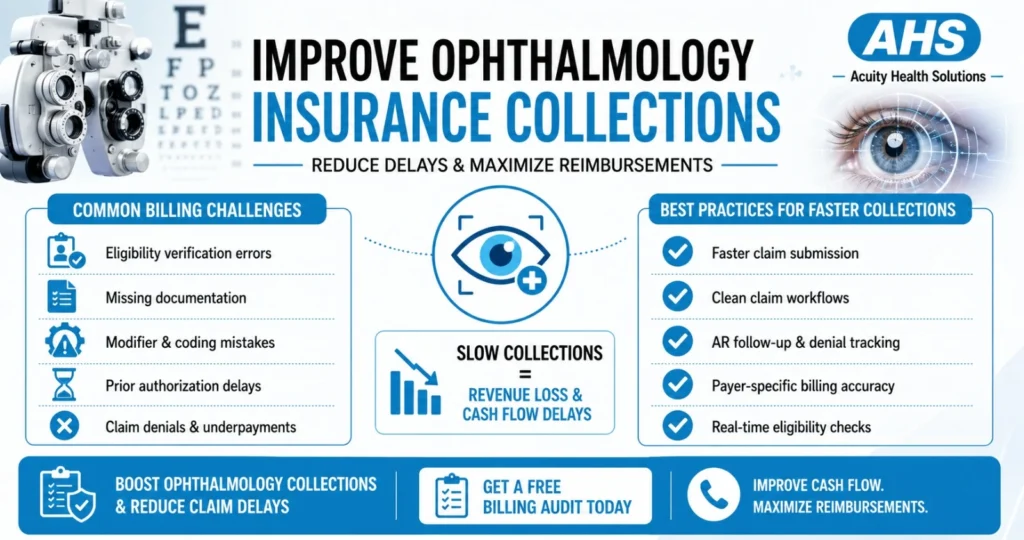
Some of the components which could delay your collections are as follows:
- Eligibility verification issues
- Incorrect modifier usage
- Missing documentation
- Prior authorization gaps
- Coding inaccuracies
- Claim submission delays
- Weak denial follow-up
- Payer-specific policy confusion
Each of these reduces the AR days, delays reimbursement and takes away revenues — directly affecting practice profits.
Why Do Denials Lead to Delays in Revenue?
Among the biggest reasons for high days in accounts receivable are claim denials.
Denied claims should be corrected, appealed, resubmitted, communicated with payers, etc., and this can cause further delays in the reimbursement process and put extra pressure on administrative tasks.
Some of the most common denial reasons for ophthalmology claims are:
- Modifier Errors
- Medical necessity issues
- Incomplete documentation
- Authorization problems
Delayed cash flow and increasing accounts receivable are common issues in practices without proactive denial management. Numerous clinics today are gearing up to tackle ways of lowering claim denials and increasing their reimbursement effectiveness.
Practices also benefit from an understanding of the key steps to managing hidden ophthalmology billing denials effectively, ultimately increasing collections performance.
Front-End Billing Accuracy Improves Collections
Better insurance collections begin with solid Front-End Billing Processes. Several claims are delayed before they are submitted because the patient’s or insurance data is incorrect.
Key front-end billing processes are:
- Real-time eligibility checks
- Coverage validation
- Referral verification
- Authorization confirmation
- Correct calculation of patient responsibility.
Addressing these workflows minimizes rejected claims, payer delay and billing mistakes. The practice of verifying eligibility in accordance with the rules is a good way to reduce the speed and consistency of the collection rate, too.
Authorization Problems That Slow Reimbursements
Prior authorizations and detailed payer approvals are required for many of the ophthalmology procedures before reimbursement can be claimed. Waiting for authorizations can lead to claim denials, payment holds, scheduling issues and slow collections.
The common authorization-sensitive services are:
- Injections
- Surgical procedures
- Specialty treatments
- Botox/Xeomin services
Billing and payer review for Botox and Xeomin can further complicate practices’ billing procedures in the ophthalmology field, affecting reimbursement schedules.
Best Practices for Faster Insurance Payments
Consistent billing oversight and proactive Revenue Cycle Management are needed to enhance the process of insurance collections.
Some effective collection strategies include:
- Faster claim submission
- Clean claim processes
- Specialty-focused coding review
- Regular AR follow-up
- Denial trend analysis
- Payer-specific workflow optimization
- Automated billing alerts
- Reporting dashboards
Going forward, a series of best practices designed to simplify billing can have a greater impact on cash flow and reimbursement delays.
Keep in Mind The Best Practices for Ophthalmology Billing Assistance
Ophthalmology billing teams specifically trained on revenue cycle management can actually simplify this process and shorten reimbursement time by taking a heavy load off of administrative staff.
Benefits include:
- Dedicated denial management
- Faster payer follow-up
- Improved clean claim rates
- Better reimbursement tracking
- Revenue analytics
- Reduced staff workload
To know more about Outsourced Medical Billing Services and transparent solutions for specialty practices,
Metrics That Reveal Collection Problems
Tracking the revenue cycle KPIs allows ophthalmology practices to identify collection issues in their practices before they can affect a large portion of their cash flow.
Important metrics include:
- Days in AR
- Clean claim rate
- Denial rate
- Net collection ratio
- First-pass acceptance rate
- Underpayment trends
- Insurance aging reports
Need Help Improving Insurance Collections for Your Ophthalmology Practice?
Learn the value of dedicated ophthalmology billing services to minimize payment delays, maximize collections and optimize revenue cycle management.