
Case Study: Helping a New Tennessee Specialty Practice Launch, Stabilize, and Grow With End-to-End RCM Support
How Acuity Health Solutions helped a Tennessee oculoplastic surgeon build a complete RCM foundation from day one and sustain it for nearly three years.
Independent specialty medical practice
Tennessee, United States
Oculoplastic / Eyelid Surgery Practice
ModMed, payer portals, clearinghouse and EFT/EDI platforms
Credentialing, payer enrollment, EFT/EDI setup,
Ongoing partnership for nearly 3 years
RCM Services
Perational Impact
Transparent. Reliable. Committed.
Driving collections and reimbursement growth.
Supporting your practice every step of the way.
Launching a new medical practice is one of the most important transitions in a provider’s career. It is also one of the most operationally demanding.
For a provider starting an independent specialty practice, the clinical side is only one part of the equation. Before the practice can function smoothly, the backend has to be ready. Payer credentialing needs to be completed. EFT and EDI enrollments need to be in place. Portal access must be set up. Billing information has to be configured correctly in the EHR.
Claims need to be submitted cleanly. Payments need to be tracked. Denials need to be worked. Reimbursements need to be monitored.
Acuity supported the practice from the earliest setup stage through ongoing end-to-end revenue cycle management, helping the provider focus on patient care and long-term practice growth.
The provider was launching a new independent specialty practice in Tennessee and needed to become operationally ready within a limited timeframe.
The practice needed much more than basic billing support. It needed a complete backend setup that would allow the provider to begin seeing patients without worrying about whether claims, payments, payer enrollments, or credentialing workflows were ready.
For a new practice, these steps are critical. If credentialing is delayed, claims may not be payable. If EFT or EDI setup is incomplete, payments and remittances may not flow properly. If payer portal access is missing, eligibility checks, claim status reviews, authorization tracking, appeals, and payment research become difficult. If billing system setup is incorrect, the practice can face avoidable rejections, denials, and collection delays.
The provider needed confidence that the backend was being handled correctly.
Acuity’s role was to make sure the practice was ready to operate from day one and that the provider did not have to carry the burden of managing credentialing, payer setup, billing, collections, and revenue cycle operations alone.

Acuity approached the engagement in two major stages:
1.Build the foundation before the practice started seeing patients.
2.Manage and optimize the revenue cycle after the practice went live.
This ensured the practice was not only launched successfully but also supported continuously as it grew.
The priority was to complete the foundational payer and credentialing work needed for the new practice.
Acuity worked with the provider during the initial setup period and completed the core credentialing and operational setup within approximately 45 days.
During this phase, Acuity supported:
This phase was essential because the provider was moving into a new independent practice structure. Acuity helped ensure that payer enrollment, billing identity, payment setup, and claim submission readiness were aligned before the practice began active billing.
Instead of the provider having to navigate payer paperwork, enrollment forms, portals, follow-ups, and technical setup alone, Acuity managed the process in the background and kept the launch moving forward.
Credentialing is only one part of practice readiness. For the revenue cycle to function properly, payments, claims, remittances, and payer communication channels also have to be in place.
Acuity helped establish the technical and financial workflow needed to support clean billing operations.
This included:
This created a stronger backend infrastructure for the practice. Claims could be submitted, payments could be tracked, remittances could be reviewed, and payer issues could be followed up without constant provider involvement.
For the provider, this meant less time spent chasing administrative setup and more time focused on building the clinical side of the practice.
Once credentialing, EFT, EDI, and access setup were underway, Acuity helped ensure the required billing information was added into ModMed.
This included reviewing and configuring key billing details so that the practice could begin submitting claims accurately once patients were seen.
Acuity supported:
This step helped reduce the risk of avoidable claim rejections or delays caused by incomplete or incorrect system setup.
By ensuring ModMed was ready from a billing perspective, Acuity helped the practice move smoothly from setup to active patient care.
After the initial credentialing and setup process was completed, the provider began seeing patients under the new practice.
At that point, Acuity transitioned from launch support into ongoing revenue cycle operations.
Acuity supported the practice with end-to-end RCM services, including:
This allowed the practice to keep the backend moving without creating additional pressure on the provider or front office team.
The provider could focus on consultations, procedures, patient experience, and schedule growth while Acuity handled the billing and collection workflows behind the scenes.
As the practice grew, new insurance plans and payer requirements naturally came up.
Instead of treating payer setup as a one-time project, Acuity continued supporting the practice whenever a new insurance plan needed to be added.
This included managing:
This ongoing support helped the practice accept and manage a broader patient base over time.
As payer participation expanded, the provider had more flexibility to schedule patients, serve more insured members, and reduce operational friction when new insurance types appeared.
Once the practice was operating steadily, Acuity moved beyond basic billing execution and began reviewing reimbursement patterns.
The objective was to make sure the practice was being reimbursed appropriately and to identify opportunities for reimbursement improvement.
Acuity supported:
This added a strategic layer to the engagement.
Acuity was not simply submitting claims and following up on denials. The team was also helping the practice understand payer behavior, protect collections, and work toward stronger reimbursement where possible.
The biggest impact of this engagement was not just that claims were submitted or credentialing was completed. The real impact was that the provider could run and grow the practice without being pulled into the daily burden of revenue cycle operations.
Acuity acted as the backend engine of the practice.
The provider was able to focus on:
Meanwhile, Acuity handled the operational details in the background.
Less Administrative Pressure
The provider did not have to personally manage payer forms, portal setup, claim follow-up, denial research, EFT issues, or billing system readiness. Acuity took ownership of these backend tasks.
More Time for Patient Care
With credentialing, payer setup, claims, and collections being managed by Acuity, the provider had more time and mental bandwidth to focus on patient care and clinical quality.
More Confidence in Collections
The practice had a team actively monitoring claims, payments, denials, A/R, and reimbursement issues. This helped reduce uncertainty around collections and gave the provider better confidence that revenue cycle issues were being worked consistently.
Better Schedule Capacity
Because backend operations were being handled, the provider and practice team were able to focus more on adding patients to the schedule instead of spending excessive time on payer and billing follow-ups.
This helped the practice grow in a more organized way.
Smoother Practice Growth
As patient volume increased and new insurance plans appeared, Acuity continued adding the necessary payer, credentialing, EDI, and EFT workflows. This allowed the practice to scale without repeatedly rebuilding its backend process.
Stronger Financial Visibility
Through ongoing claim follow-up, reimbursement review, and payer issue tracking, Acuity helped the practice gain better visibility into collections, payment behavior, and payer performance.

Acuity’s support helped the practice move from startup stage to stable operations.
Key outcomes included:
Area | Before / Launch Stage Challenge | Acuity’s Role | Practice Impact |
|---|---|---|---|
Credentialing | New practice needed payer participation | Managed credentialing and payer enrollment | Practice became payer-ready for patient care |
EFT / EDI | Payment and claim flow needed to be established | Completed EFT, EDI, and clearinghouse coordination | Cleaner payment and remittance workflow |
Portal Access | Payer portals needed for claim, eligibility, and authorization work | Set up and managed access requirements | Faster backend payer follow-up |
ModMed Setup | Billing information needed to be configured correctly | Added and validated required billing details | Reduced risk of claim submission issues |
Claims and Collections | Practice needed ongoing billing support after launch | Managed claim submission, follow-up, denials, and A/R | Provider had less RCM burden |
Growth Support | New insurance plans appeared as patient volume increased | Managed new credentialing, EDI, and EFT needs | Practice could support more patients and payer types |
Reimbursement | Payment rates and payer behavior needed review | Supported reimbursement review and rate renegotiation | Stronger focus on proper reimbursement |
This engagement highlights Acuity Health Solutions’ ability to support a medical practice through the full lifecycle of revenue cycle growth.
Many billing companies enter after a practice is already operational. Acuity was involved before the first phase of active billing began.
The team helped build the foundation:
This full-service approach helped the provider avoid the common startup burden of trying to manage clinical care, payer enrollment, system setup, billing, collections, and reimbursement issues at the same time.
Acuity helped create a backend structure that allowed the provider to focus on building the practice.
The long-term value of the engagement came from consistency.
Acuity was not just a vendor completing one setup task. Acuity became an extension of the practice’s backend operations.
For nearly 3 years, the provider has had a team supporting the revenue cycle, payer communication, collections, and reimbursement workflows.
This has helped the practice maintain stability while continuing to grow.
The provider did not have to constantly worry about whether claims were being followed up, whether denials were being worked, whether payments were being monitored, or whether new payer setup requirements were being handled.
Acuity managed those details in the background.
That operational relief allowed the provider to spend more time on the work that mattered most: seeing patients, delivering care, and growing the practice.

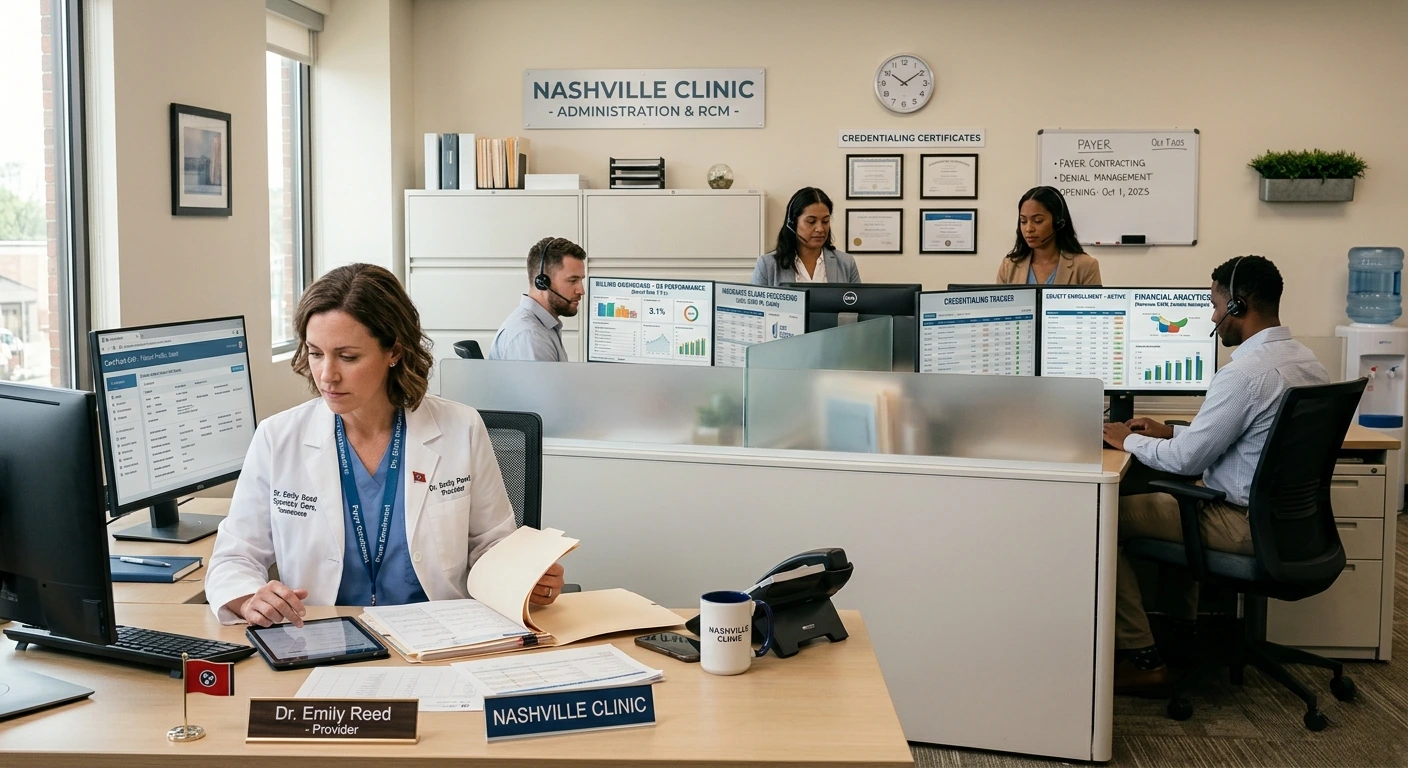
Starting a new specialty practice requires a strong operational foundation. Credentialing, payer enrollment, EFT, EDI, portal access, billing system setup, claims, denials, collections, and reimbursement review all have to work together.
For this Tennessee-based specialty provider, Acuity Health Solutions helped build that foundation and continued supporting the practice as it grew.
Within the initial 45-day setup period, Acuity helped complete the core credentialing and payer-readiness work needed to support the practice launch. After the provider began seeing patients, Acuity transitioned into ongoing end-to-end revenue cycle support.
Over time, the engagement expanded to include new payer setup, EDI and EFT coordination, claims management, denial follow-up, A/R, reimbursement review, and payer rate renegotiation support.
Nearly 3 years later, the practice continues to run smoothly, with Acuity managing the backend revenue cycle operations and helping the provider stay focused on patient care and growth.
This case study reflects Acuity Health Solutions’ strength in helping specialty practices launch, stabilize, and scale with confidence.
Acuity Health Solutions helps specialty practices with credentialing, payer enrollment, EFT/EDI setup, billing system readiness, claims management, denial follow-up, A/R, and reimbursement optimization.
Contact Acuity Health Solutions to build a stronger revenue cycle foundation for your practice.