

Oculoplastic procedures are ophthalmology procedures involving reconstructive and cosmetic surgery around the eyes. Due to the sensitivity of the organs operated during this type of service, the need to perform surgery meticulously, and the tedious record-keeping and billing, can sometimes be complicated. Coding and payer compliance play a crucial role in avoiding denials and providing the right reimbursement.
In the case of eye clinics and surgical centers, it is essential to learn the basics of oculoplastic billing, particularly CPT codes, modifiers, and payer requirements to maintain a viable revenue cycle.
What Is Oculoplastic Billing?
Oculoplastic Billing is a process of coding and reimbursement of surgery of the eyelid, tear ducts, orbit, and facial parts as well. These surgeries can be done to accomplish both functional and cosmetic purposes.
Common conditions treated in oculoplastic surgery include:
- Eyelid drooping (ptosis)
- Eyelid malposition (entropion or ectropion)
- Excess eyelid skin (dermatochalasis)
- Tear duct obstruction
- Orbital tumors or trauma
Owing to the fact that most of these procedures consist of functional and cosmetic elements, there is a need to document and code them with care in order to establish insurance coverage.
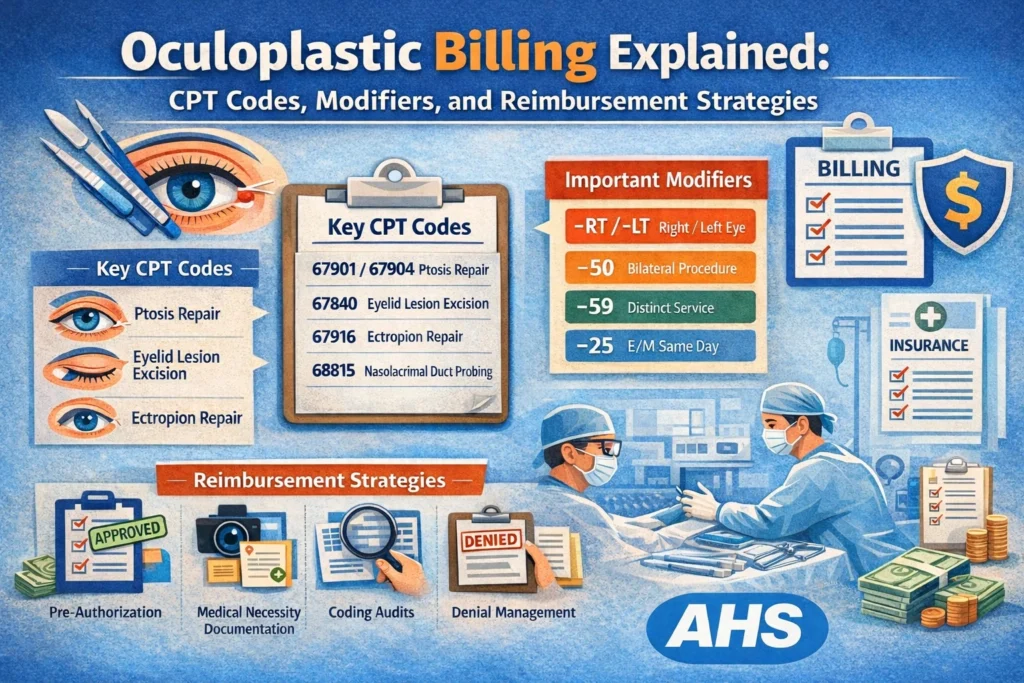
Key CPT Codes Used in Oculoplastic Procedures
Proper reimbursement is based on the proper code of CPT. Oculoplastic CPT Codes are commonly used, and some of them are:
- 67901 / 67904 – Repair of blepharoptosis (ptosis repair)
- 67840 – Excision of eyelid lesion
- 67916 – Correction of ectropion
- 67924 – Repair of entropion
- 68761 – Closure of lacrimal punctum (punctal occlusion)
- 68815 – Probing of the nasolacrimal duct with irrigation
Every procedure should be backed up by the proper clinical report, such as the symptoms, examination results, and the necessity of the medical care.
Important Modifiers in Oculoplastic Billing
Oculoplastic claims also often need the use of modifiers since there are cases where there are two or more services carried out on the eyes or even in the course of one and the same surgery.
Some commonly used modifiers include:
- Modifier -RT / -LT – Indicates right or left eye
- Modifier -50 – Bilateral procedure
- Modifier -59 – Distinct procedural service
- Modifier -51 – Multiple procedures
- Modifier -25 – Separate evaluation and management service on the same day
Modifiers may be wrong or omitted, resulting in payment cuts or claims rejection.
Documentation Requirements for Reimbursement
The oculoplastic procedures are subject to scrutiny by insurance companies because of the possibility of the procedures being cosmetic.
Functional impairment must be clearly seen through proper documentation to justify coverage.
Important documentation elements include:
- Patient symptoms include visual or everyday activities
- Findings of clinical examination
- Diagnostic testing results (such as visual field testing)
- Preoperative photographs, when required
- Detailed operative notes
Insurers can categorize the procedures as cosmetic and not pay them without adequate documentation.
Reimbursement Strategies for Oculoplastic Practices
More than just coding, the right coding is needed in order to optimize reimbursement outcomes. Structured billing plans also need to be adopted by the practice, and these may include:
Pre-authorization verification
Certain procedures carried out in oculoplastics are not allowed without prior authorization, particularly where functional medical necessity needs to be proved.
Accurate medical necessity documentation
Clear documentation will avoid the denials in terms of cosmetic procedure exclusions.
Regular coding audits
Regular audits can be conducted to check the accuracy of the CPT codes and modifiers.
Denial trend analysis
Tracking of denial patterns assists in establishing repetitive problems in coding or documentation.
The Role of Specialized Billing Support
Oculoplastic surgeries are high-value claims, which are surgically complex and are highly payer-demanding. The collaboration with established Medical Billing experts may assist the practices with lowering denials, enhancing the accuracy of the codes, and keeping in line with the payer policies.
The documentation review, claim submission, denial management, and reimbursement optimization are often offered through the services of professional revenue cycle management teams that primarily support practices.
Conclusion
Oculoplastic billing involves a lot of coordination between clinical records, proper use of CPT codes, and appropriate use of modifiers. Since all these procedures can coincide with cosmetic services, it is necessary to prove their medical necessity to be reimbursed.
Through powerful billing systems, well-documented records, and a tracking system of the payer, ophthalmology practices can increase the rate of claim approval, secure revenue, and provide specialized care to the patient.