
Hidden billing denials remain a challenge that is only increasing in Ophthalmology practices across the U.S. These rejections, as opposed to the obvious ones, tend to take the lower forms of underpayments or silent write-offs or even claims that stall down unnecessarily. To eye clinics that are employing narrow margins, such hidden sources of leaks can silently undermine the profitability.
Nowadays, it is necessary to comprehend the origin of these denials, as well as how to avoid them, in order to be financially sustainable.
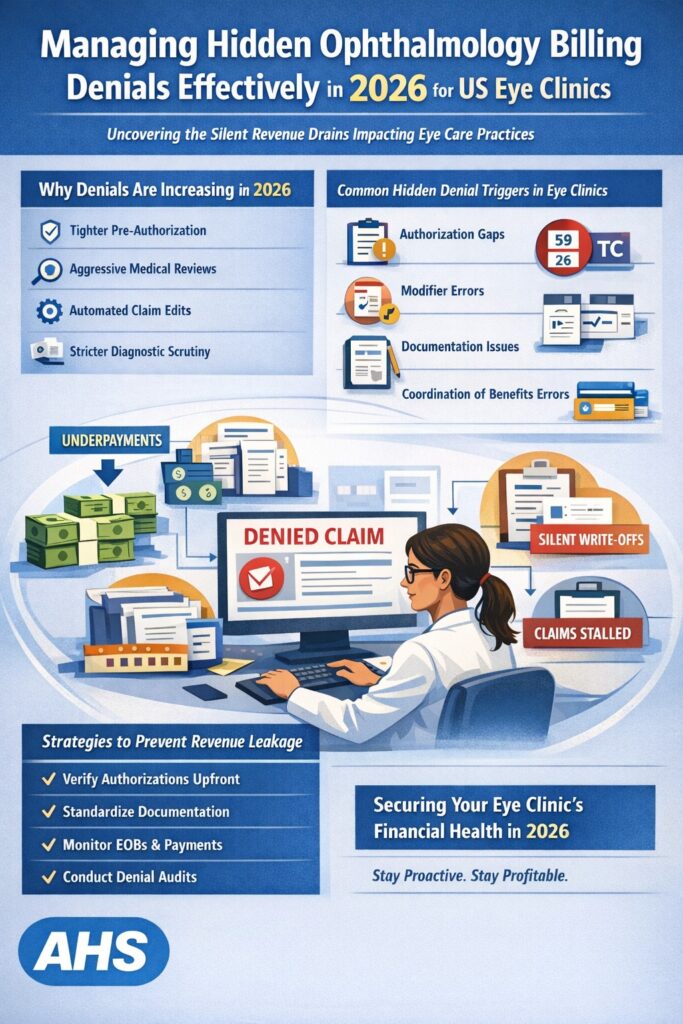
Why Ophthalmology Denials Are Increasing in 2026
The Ophthalmology Bill contains a special combination of medical and surgical services, diagnostic tests, and processes associated with vision. All categories have varying payer regulations, documentation clauses, and approval rules. With increased utilization control by the payers, the denial risk has increased in a number of high-volume service lines.
The main sources of contribution are:
- Enlarged advance permission of imaging and injections.
- Increased aggressive review of medical necessity for cataract and retina procedures.
- Greater questioning of the diagnostic protocol, such as OCT, the field of vision, and fundus photography.
- Increasing reliance of payers on automated claim edits.
These developments imply that some technically clean claims can be either partially paid (or not paid at all) without being actively monitored.
Common Hidden Denial Triggers in Eye Clinics
Authorization Gaps
Ophthalmology procedures have become a pre-authorized procedure, especially retina injection, special imaging services as well as some types of surgeries. Silent denials or delayed payments are common in cases where the authorizations are missing or expired.
Modifier Misuse
The faults in using the wrong modifiers like -26, -TC or -59 can often make the bundled services or decrease payment. These mistakes are particularly typical in the cases of billing global and professional elements of diagnostic testing.
Diagnostic Test Documentation Issues
Cataract and other ophthalmic procedures are highly scrutinized in regard to medical necessity, laterality, and details in the operations. The report of missing supportive notes or inappropriate coded notes may also lead to partial payments or recouping of payment after the fact.
Incomplete Surgical Documentation
Cataract and other ophthalmic surgeries are closely reviewed for medical necessity, laterality, and operative details. Missing supporting notes or inconsistent coding can result in partial payments or post-payment recoupments.
Coordination of Benefits Errors
Healthcare insurance companies have a large number of ophthalmology patients with medical and vision plans. Wrong designation of primary payer frequently results in rejection of claims or misdirected claims.
Why These Denials Are Often Missed
Denial of access normally does not manifest itself with rejection being made formal. Instead, they show up as:
- Lower reimbursement levels.
- The unpaid claims with the mark of processed.
- Incorrect payment made.
- In explaining the services that have been bundled.
These can be hidden in the old accounts receivable unless supplies of organized denial analytics and payment variances are installed.
Strategies to Prevent Ophthalmology Revenue Leakage
In 2026, eye clinics will have to forget about reactive billing and proactive prevention methods:
- Check entitlements and approval mandates prior to all high-cost services.
- Standardize documentation forms on diagnostic testing and injections.
- Use charge capture rules of payer-specific coding.
- Track terms of explanation of benefits (EOBs) overpayment.
- Conduct routine payer and procedure denial trend analysis.
Another very crucial thing is training clinical team and front-desk staff to understand that accuracy in documentation and intake directly affect reimbursement.
How Acuity Health Solutions Supports Ophthalmology Practices
Acuity Health Solutions assists ophthalmology clinics in detecting and fixing latent denials with the help of payer-aligned workflows, specialty-specific code management, and highly sophisticated denial analytics.
As opposed to losing revenue, Acuity is focused on prevention, i.e. reinforcement of eligibility verification, authorization tracking, alignment of documentation, and reconciliation of payment.
Final Thoughts
Denials of hidden ophthalmology are not a billing problem anymore, but this is a system-wide revenue risk. The eye clinics in 2026 that will succeed will involve those that take charge of the authorization processes, documentation guidelines, and payer-based regulations. By having the right RCM strategy in place, the practices are able to protect the revenue, enhance efficiency in operations, and keep providing high-quality patient care.