
In the case of small and mid-sized medical practices, revenue leakage is not due to a single large error–it is always occasioned by dozens of mistakes in charge capture every day, each month. Omissions of procedures, delays in documentation entry, erroneous modifiers, and unfinished documentation silently contribute to denied claims, underpayments, and mounting accounts receivable.
Technical Healthy Revenue Cycle is based on the principle of a clean charge capture process. When the capturing of charges is precise and timely, all the downstream activities, such as coding, billing, reimbursement, and reporting, become predictable.
Here’s how practices can build a reliable, compliant charge capture workflow.
Start with Standardized Clinical Documentation
Capturing of the charge starts in the exam room. Even the best billing team will fail to code correctly if providers fail to document accurately.
Practices ought to be provided on structured templates that capture what is clear:
- Associated diagnoses with every service.
- Procedures performed
- Start/Stop time of time-based services.
- Medical necessity details
- Modifiers when applicable
Standardised paperwork minimises interpretation mistakes and enables coders to have the clinical information needed to authenticate a claim.
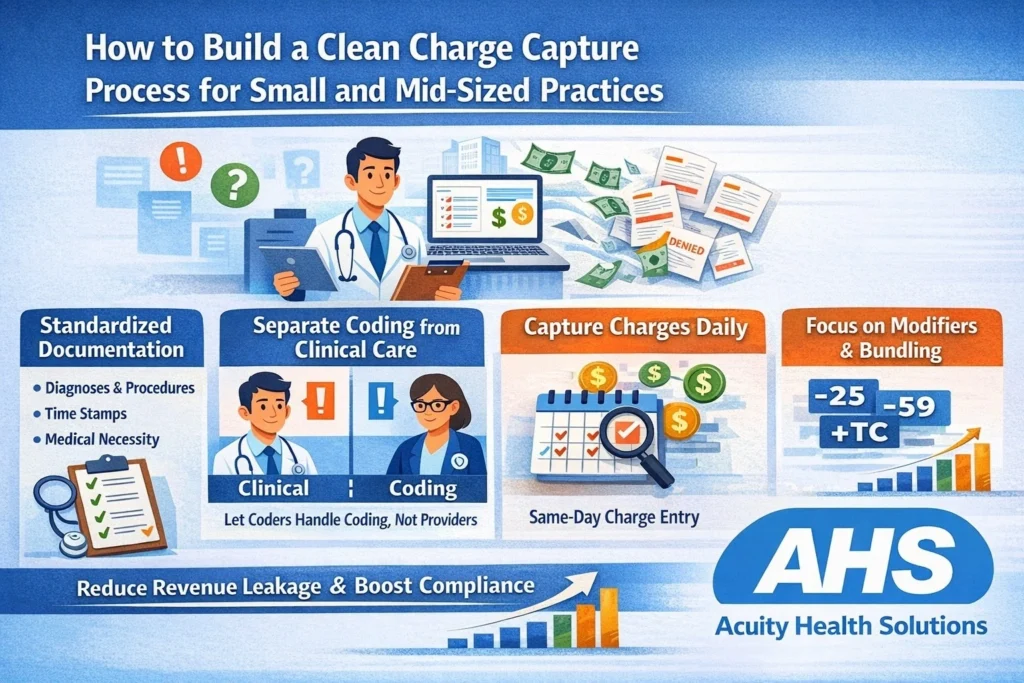
Separate Clinical Care from Coding Responsibility
Clinical care and not coding complexity should be placed on the providers.
The typical error in the smaller practices is to base the CPT codes selection directly on the clinicians. This tends to result in undercoding or omission of billable services. Rather, the coders should be well documented with codes being assigned to providers as per the payer rule and standards of compliance.
Such isolation enhances accuracy and cushions the providers against unintentional compliance risks.
Capture Charges Daily & Not Weekly
Among the revenue loss causes that have been underestimated is delayed charge entry. Detailed information is forgotten, and no services are billed when the charges are entered days or weeks later.
Same-day or next-day charge capture with the support of best practices
- Reconciliation on a daily basis.
- Automated EHR charge queues.
- Workflows of front-desk and clinical handoff.
Early charge recording reduces the time spent on bills and increases the consistency of cash flow.
Implement Charge Reconciliation Checks
Every scheduled patient should generate either a charge or a documented reason for no charge.
Basic reconciliation mechanisms are used to identify absent services:
- Compare the schedules of appointments and posted charges.
- Checking of procedure logs with billing reports.
- Audit these high-volume services per week.
These counterchecks are fast to detect loopholes prior to receipt of claims.
Pay Close Attention to Modifiers and Bundling Rules
Silent revenue loss often occurs as a result of Modifiers. Wrong or omitted modifiers may result in bundled or reimbursed services against the reduced rates.
Small practices have problems with:
- Modifier -25 for same-day E/M services
- Modifier -59 for distinct procedures
- Professional vs technical components
The periodic audits of the modifiers can be used to avoid underpayments, which seldom lead to formal denials.
Use Technology – but Don’t Rely on It Alone
The existing EHR systems provide tools for charge capture, prompts, and automation. Technology is beneficial, but should not be used instead of human supervision.
Still, automated systems need:
- Coding review
- Documentation validation
- Payer-specific rule checks
After all, successful practices are automated with trained revenue cycle professionals.
How Acuity Health Solutions Supports Clean Charge Capture
Acuity Health Solutions assists small and mid-sized practices to enhance charge capture by designing workflows, methods of coding oversight, and preventing denials. Instead of responding to denials of claims, Acuity concentrates on front-end accuracy, ensuring that documentation, coding, and payer requirements are in line with the submission.
This is a proactive strategy that minimizes billed transactions, enhances first-pass claim collection, and generates predictable revenue performance.
Final Thoughts
Clean charge capture does not mean concentrating on accomplishing a great deal, but doing so intelligently. Small and mid-sized practices can significantly decrease revenue leakage by having standardized documentation, timely entries, checks and balances, as well as coding skills.
An effective charge capture procedure saves reimbursement, aids compliance, and enables providers to do what they care about most, which is to provide quality care to patients.