
Eligibility check in the case of the present complex reimbursement environment is one of the most important processes in the revenue cycle. Incompleteness and inaccuracy of coverage information may also result in rejection, delay, and underpayment of perfectly coded claims. In the case of organizations such as Acuity Health Solutions and the providers to which they are connected, one of the quickest methods to enhance cash flow and decrease the workload is to tighten the eligibility processes.
The following are the best practices in eligibility verification, which allow for minimizing downstream claim denials and enhancing the performance of the staff and the patient experience.
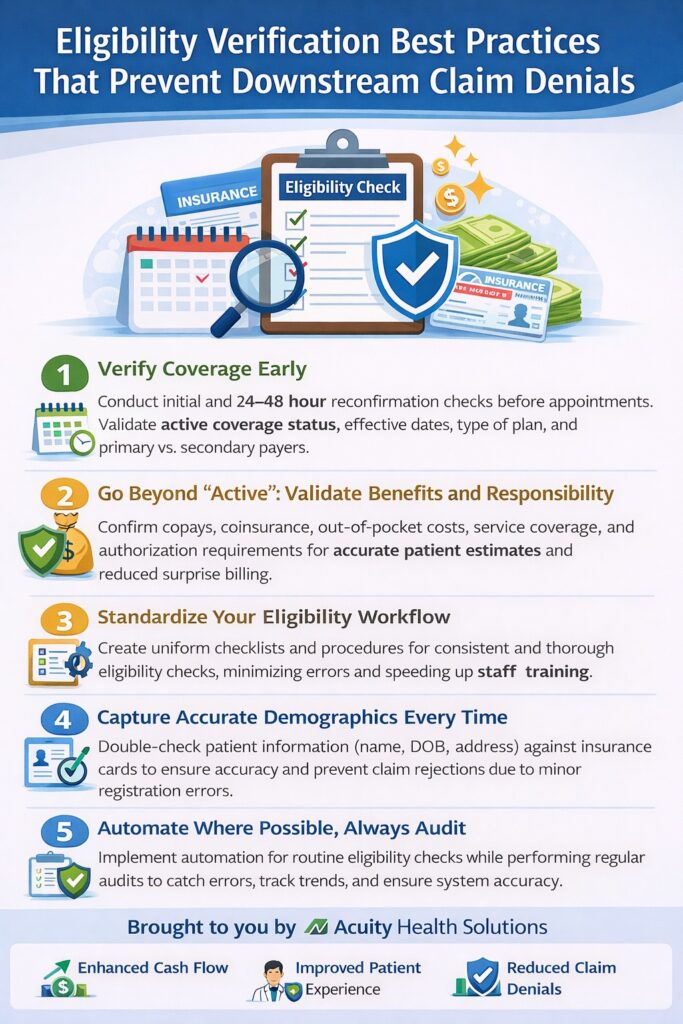
1. Verify Coverage Early
Eligibility ought to be checked at scheduling or pre-registration, but re-checked within a period of 24-48 hours of the appointment. The insurance cover may vary rapidly based on switching jobs, renewing plans, or terminating plans. Same-day recheck is useful in identifying updates made late to avoid emerging as claim denials.
The main aspects that should be checked are:
- Active coverage status
- Efficient and termination dates.
- Primary vs. secondary payer
- Type of plan (HMO, PPO, Medicare Advantage, etc.)
2. Go Beyond “Active”: Validate Benefits and Financial Responsibility
It is not sufficient to make sure that a policy is active.
The best Revenue Cycle teams will also check:
- Out-of-pocket and balances.
- Copays and coinsurance
- Services and exclusions
- Referrals/authorizations requirements
This higher order of validation helps to do proper estimations and cleaner claims. It also enables the staff to receive patient responsibility at the outset- bad debt and surprise billing are minimized.
3. Standardize Your Eligibility Workflow
Inefficient processes result in inefficient outcomes.
Develop standardized eligibility checklists and documentation needs in order to ensure that all personnel at the front office or registering people take the same route. This should include:
- At which location is the eligibility information obtained (payer portals, clearing houses, or EHR tools)
- The way coverage discrepancies are amplified.
- The documentation of benefits within the system.
- When authorizations are set to go off.
Eliminating mistakes and simplifying the training of new employees substantially, standardization is much easier.
4. Capture Accurate Demographics Every Time
Minor registration mistakes have massive implications in the future.
The misspelled names, incorrect dates of birth, or old addresses may cause a claim rejection despite the coverage. The staff at the train should be trained to verify the demographics in verbal form at each meeting and identify them because they have to be identical to the insurance card.
Another form of protection is the encouragement of having up-to-date insurance cards with the patients, including scanning both sides.
5. Automate Where Possible, but Always Audit
Eligibility checks can be checked by automation that saves much time and decreases manual work. Nevertheless, ownership of the automation process should not be to the detriment of human monitoring of the same.
Periodic check-ups of eligibility results are used to detect trends, common payer problems, training voids, or problems with system set-ups. Opting to combine automation with quality control would make sure that no efficiency is traded at the expense of accuracy.
6. Stay Aligned With Payer and Regulatory Requirements
The payer regulations are volatile, particularly for government programs under the management of the Centers for Medicare and Medicaid Services. Raising awareness among the staff about coverage policy, authorization regulations, and documentation standards is an important aspect of preventing avoidable denials.
Continued training and payer refresh must be included in your working mood not a yearly affair.
Conclusion
The eligibility check is not just a front-end process but an effective strategic tool to block any rejection.
Healthcare organizations can tackle downstream claim denials by ensuring early verification, benefits validation, workflow standardization, ensuring accurate demographics, using automation in a responsible manner, and keeping up with payer rules. The outcome is healthcare claims that are cleaner, paid faster, and a more seamless financial process that is experienced by providers and patients.
Should you need assistance with enhancing your process of verifying eligibility or your performance in the entire revenue cycle, Acuity Health Solutions collaborates with organizations to transform the front-end precision into the back-end monetary achievement.