
The consultations and procedures used in dermatology practice are a special mix that can be conducted in the same visit of a patient. Indeed, dermatologists often offer both Evaluation and Management (E/M) services and procedures at the same day based on acne appraisals, biopsies and removal of lesions. This generates a complexity in billing and aggravates the chances of rejection of claims in case documentation and coding is not performed properly.
To have successful dermatology billing, it is necessary to know the difference between E/M billing and procedure billing and when to use Modifier 25 to get the highest possible reimbursement.
Understanding E/M vs Procedure Billing in Dermatology
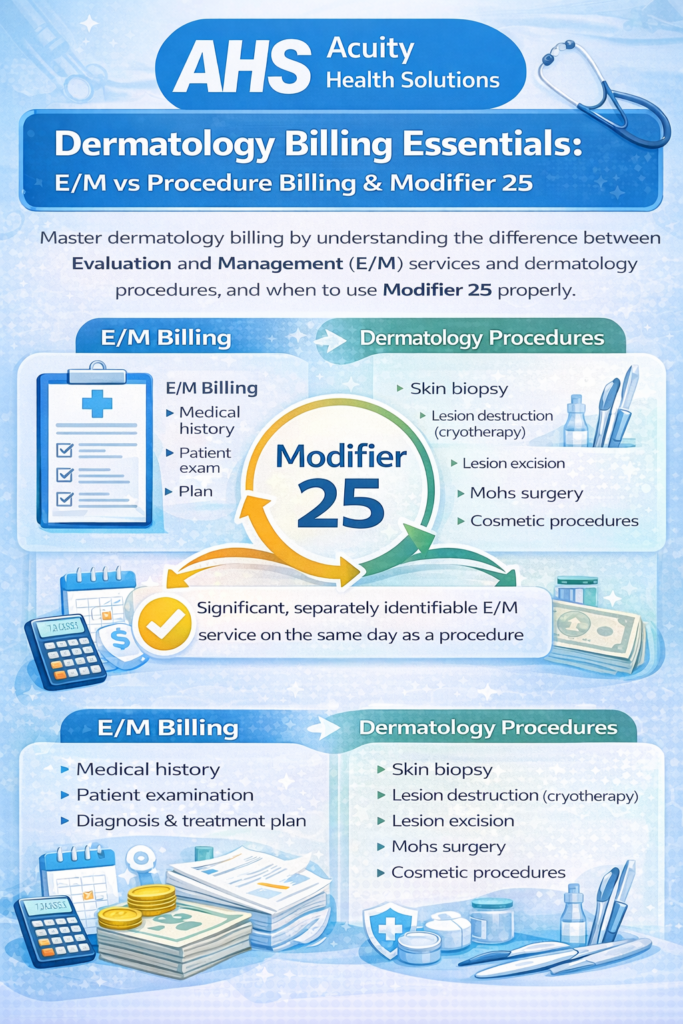
The cognitive component of an encounter with a patient is represented by Evaluation and Management (E/M) services. Such visits include checking medical history, looking at the patient, diagnosing and formulation of treatment.
On the other hand, procedural services are the ones that include the execution of a certain treatment or a diagnostic intervention. The standard dermatology procedures are:
- Skin biopsies
- Lesion destruction (cryotherapy)
- Excision of benign or malignant lesions
- Mohs surgery
- Cosmetic procedures
The problem is in the case when both services are taken within the same visit. The routine examination that is needed to conduct such a procedure is already set out in specific procedures codes, and thus, billing both individually must be justified.
What Is Modifier 25 in Dermatology Billing?
A provider must use modifier 25 with the condition that he or she will give a severe and identifiable E/M service on the same day as a procedure.
This is typical in the dermatology field. A patient can bring several skin issues, as an example. When making the visit, the doctor conducts a biopsy on a suspicious lesion. When the assessment of the physician extends past the routine assessment required to take the biopsy, he or she may bill the E/M visit separately with the help of Modifier 25.
This modifier informs the payer that the E/M service was different as compared to the procedure and was medically necessary.
When Modifier 25 Should Be Used?
The use of modifier 25 must require documentation of the fact that the doctor has conducted an independent assessment of the practice covered by the procedure on top of the standard practice.
Common scenarios include:
- Assessment of various skin-related ailments prior to biopsy.
- Evaluation of a recent case of a dermatologic complaint and a minor surgical procedure.
- Chronic dermatologic disease management with a procedure intervention.
In such instances, the E/M service has to be notable, medically essential, and distinctly represented.
When Modifier 25 Should NOT Be Used
One of the most frequent Dermatology Billing errors is an incorrect use of Modifier 25. It is not the thing to rely on when the assessment carried out is merely the part of the regular pre-procedure assignments.
For example:
- Confirming the lesion location before removal.
- Getting the permission to carry out the process.
- Making a simple pre-procedure examination.
These tasks are already included in the procedural code and cannot be billed separately.
Documentation Requirements for Compliance
Dermatology billing should be phased out properly documented. Billing an E/M service which has a procedure:
- Record the need to make the assessment medically.
- Divide the E/M note and the procedure documentation.
- Indicatively detail the extra examination carried.
- Both services need to be supported by the diagnosis codes.
Excellent documentation secures the practice when being reviewed by the payers and also aids in minimizing the risk of denial.
Why Dermatology Practices Need Specialized Billing Support
Dermatology is a specialty that engages a high number of same-day surgeries and check-ups hence a high sensitivity to payer audits. Research indicates that the proportion of E/M services claims in conjunction with procedures in dermatology is very high, and this may raise compliance personnel.
Specialized dermatology billing teams help ensure:
- Effective procedure and E/M visit coding.
- Proper modifier usage.
- Full wages and hour administration.
- Minimized decline in claims and audit risk.
Final Thoughts
One of the most significant aspects of compliance in the dermatology Revenue Cycle Management is E/M vs procedure billing. Modifier 25 can be used properly to enable practices to receive valid reimbursement of more clinical effort conducted during the same visit.
But, when it was misused or has been poorly documented, then it results in denials, delays in payment or even audit. Dermatology practices can promote revenue protection and full achievement of payer policy compliance by implementing sound billing workflows and codes of conduct.