

Denied or rejected claims are costing healthcare practices considerable sums of money on an annual basis. Although preventable denials are there, some are ineluctable, and many are due to avoidable mistakes in terms of eligibility checks, coding, documentation, or claims. When there is no well-organized denial management plan, such unpaid claims will add up within a short time and therefore affect the cash flow negatively.
An effective denial management playbook to assist healthcare organizations in determining the underlying causes, loss of revenue, and elimination of repetitive claim errors. In Acuity Health Solutions, denial management is considered an active revenue cycle operation and not an administrative reactive action.
Understanding the Difference Between Rejections and Denials
When introducing a denial recovery strategy, one should have the difference between rejected and denied claims that should be understood.
A rejected claim does not pass preliminary validation and many of these fail because of missing information, formatting, or even incorrect patient data. The claims do not undergo the adjudication procedure of the payer and can be easily rectified and resubmitted in a short period of time.
The payer, in turn, overturns the denied claim but concludes that it does not have to be paid because of reasons like not being medically necessary, authorization issues, or wrong coding.
The identification of such differences will enable the billing teams to focus on quicker corrections of claims and targeted appeals.
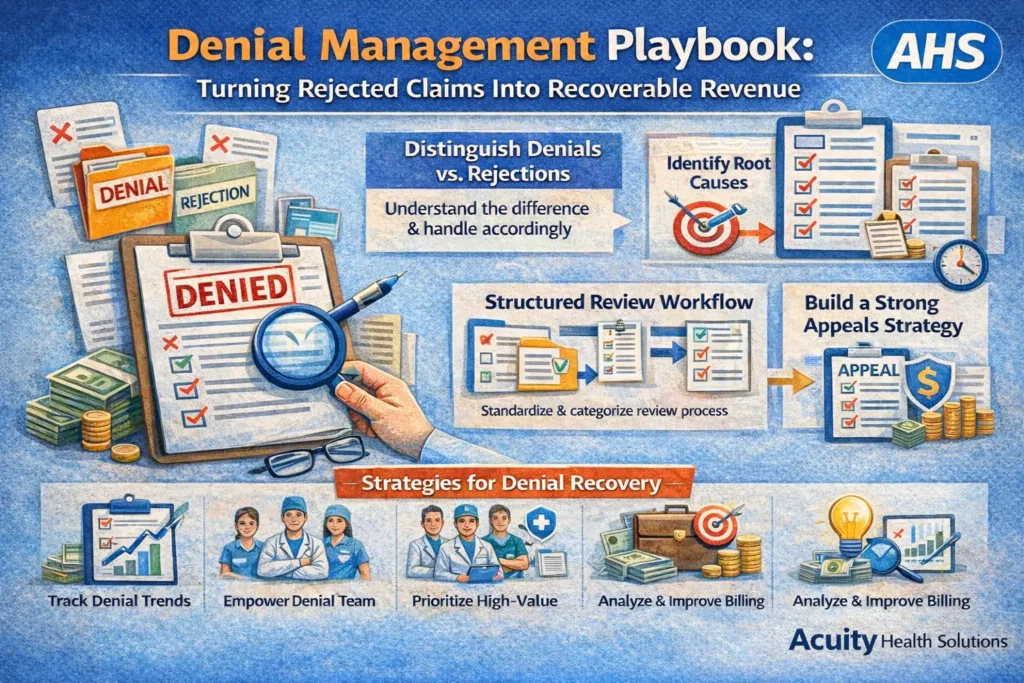
Identify Root Causes of Claim Denials
Handling denials properly is done by first of all understanding the reason of the denials. Some of the commonplace denial triggers are:
- Inaccurate or incomplete patient eligibility verification
- Missing prior authorizations
- Incorrect CPT or ICD-10 coding
- Insufficient documentation of medical necessity
- Modifier errors or bundling violations
- Timely filing issues
Following the trends of denials per payer, type of procedure, and department would seem to identify systemic problems that need to be improved upon in the process.
Implement a Structured Denial Review Workflow
There should be a standardized system of reviewing rejected claims in healthcare practices. A formalized flow of work usually contains:
- Denial categorization according to reason codes.
- Reviewing records and the validity of coding.
- Fixing errors on claims where there are.
- Resubmission of corrected claims in time.
- Launching requests for the medically necessary services.
Timely review is critical. Most of the insurers have very strict deadlines within which they should appeal, and a timely appeal is a good step towards getting back revenue.
Strengthen Front-End Processes to Prevent Denials
The best denial management plan concentrated on prevention. Claim rejections may be reduced dramatically by increasing Front-End Revenue Cycle Operations.
Best practices include:
- Checking the eligibility of insurance prior to the offices.
- Establishing referral and authorization mandates.
- Obtaining correct patient demographic data.
- Going to the providers and obtaining full documentation.
By solving such problems at the initial stages, the practices will minimize the chance of claims being denied in later billing periods.
Use Data Analytics to Track Denial Trends
The modern Revenue Cycle Management is based on the insights of data. Denial analytics are utilized to track performance metrics of:
- First-pass claim acceptance rate
- Denial rate by payer
- Average days to resolve denied claims
- Financial value of recovered claims
These indicators can help to understand the leakage of revenue and give strategic recommendations on how the billing operations can be improved.
Build a Strong Appeals Strategy
Neither should all denied claims be written off. A significant number of them can be retrieved by adequately prepared appeals with clear clinical records.
A successful appeal typically includes:
- Easy definition of medical necessity.
- Contemporary patient record support.
- Corrected coding where it is necessary.
- Clinical guideline or payer policy reference.
When the proper appeal procedures are put in place, the odds of succeeding in reversing the denials and reimbursements.
Final Thoughts
Denied claims do not necessarily mean lost revenue because of the denied claims. Through a comprehensive denial management game plan, healthcare systems will have the capacity to collect payments, enhance the accuracy of billing, and enhance financial performance over time.
Proactive denial management is not just appropriate revenue protection but also establishes a stronger and more efficient revenue cycle since the providers are free to take care of patients on a more appropriate level.