

Behavioral health practices have adopted telehealth in the last several years- yet much of the billing problems are well beyond virtual care. With more providers moving towards either in-person or hybrid approaches, documentation, coding, authorizations, and payer compliance areas become new areas of revenue cycle risks. Among the working practices that utilize health solutions, it is necessary to become aware of these pitfalls to safeguard reimbursement and financial stability.
Why Behavioral Health Billing Is Uniquely Complex
Behavioral health billing is a stark contrast in comparison to conventional Medical Billing. Services tend to be session-based, documentation is more narrative, and payer requirements are highly variable depending on diagnosis type, type of provider, and setting. This becomes more complicated in hybrid models, where care is provided both online and in real life.
The most frequent issues are cases of inconsistent coding across modalities, imprecise records of medical necessity, and continual changes in payer policies. It is not due to an inappropriateness of the services, but rather that documentation or authorization processes were not finished, or rather, not properly matched against payer expectations.
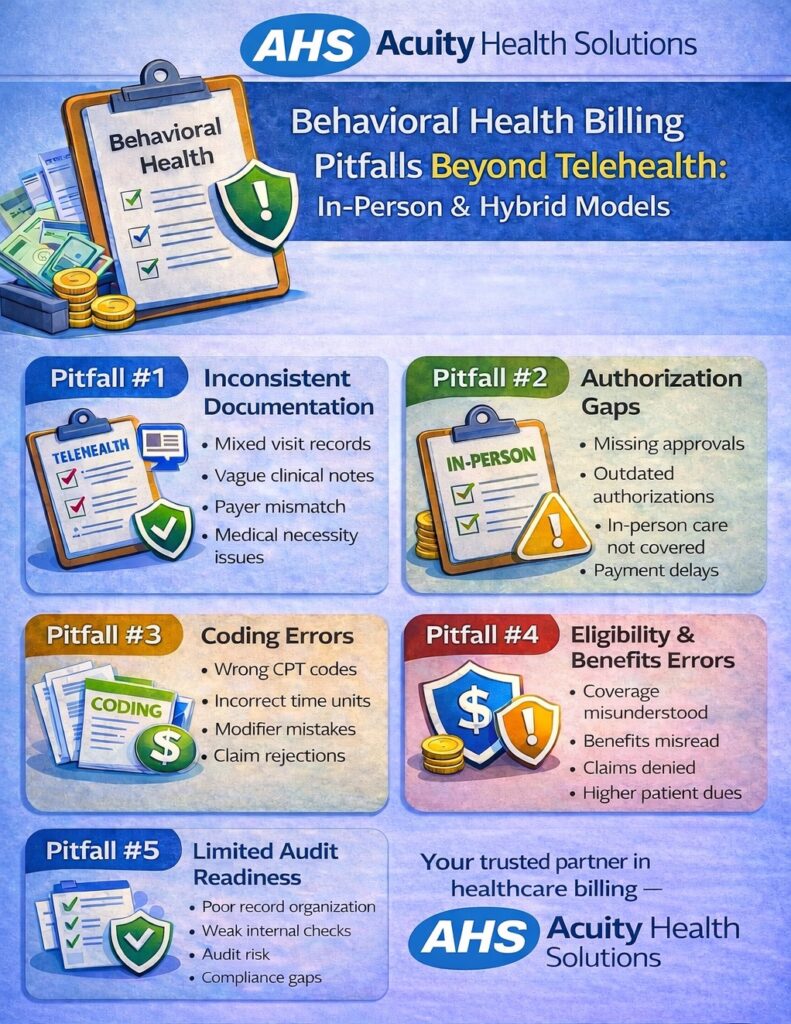
Pitfall 1: Inconsistent Documentation Between Visit Types
Mixed records on documentation standards are among the most frequent problems of hybrid practices. Telehealth visits have templates, whereas face-to-face ones can utilize free-text notes. The clinical detail required by payers is the same whether provided in a delivery method or not.
The lack of treatment plans, vague progress notes, or no clear durations of sessions may cause denials or post-payment audits. All encounters should have a clear support of medical necessity, diagnosis relevance, and time-based billing, particularly psychotherapy and substance use services.
Pitfall 2: Authorization Gaps for In-Person Services
Although telehealth authorization processes nowadays are commonplace during the pandemic, most practices encounter difficulties in getting the patients back to face-to-face systems. Other payers also mandate distinct or renewed approvals of on-site visits, intensive outpatient programs, or partial hospitalization services.
Inability to verify the demands of authorizations before the provision of services would, in most cases, translate to unnecessary rejections. When care settings are changed, hybrid practices should recreate benefits and authorization regulations.
Pitfall 3: Coding Errors in Session-Based Services
CPT codes dependent on time are important to behavioral health. Minor (10) and insignificant differences, e.g., billing a 60-minute psychotherapy but providing a 45-minute session, may lead to downcoding or refusal.
Additional risks include:
- Incorrect use of add-on codes
- Offering billing services is regarded as not within the licensure of a provider.
- Incorrect use of modifiers in the case of E/M and the therapy on the same day.
These mistakes are particularly frequent in situations where practices broaden service models without revising their workflow regarding the coding process.
Pitfall 4: Eligibility and Benefits Misinterpretation
Such benefits as mental health are usually not similar to medical benefits and have different deductibles, visit limits, or coverage exclusions. Within the context of hybrid settings, front-desk units can ensure that general eligibility is met but fail to recognize the behavioral health restrictions.
This causes unsuspected patient balances, payments, and an increase in bad debt. One of the best methods of averting downstream loss of revenue is proper benefit verification at the intake.
Pitfall 5: Limited Audit Readiness
Behavioral Health Claims are also commonly denied because of the standards of medical necessity and documentation sensitivity. The unstructured audit-ready practices – organized records, regular templates, and internal checks and balances- are more prone to payer recoupments.
An additional aspect of hybrid care is that the pattern of documentation between telehealth and in-person might be inferred by the auditors as inconsistencies.
Final Thoughts
With the continued transformation in behavioral health care beyond the telehealth approach, revenue cycle practices have to align their revenue strategy to the changes. Face-to-face and hybrid solutions introduce special billing opportunities, which need to be addressed through disciplined workflow, payer consciousness, and continuous monitoring of their compliance.
By avoiding these traps in advance, behavioral healthcare providers will be able to safeguard revenue, enhance access to care among patients, and develop a stable financial base in a reimbursement landscape that is becoming more complicated with time.