
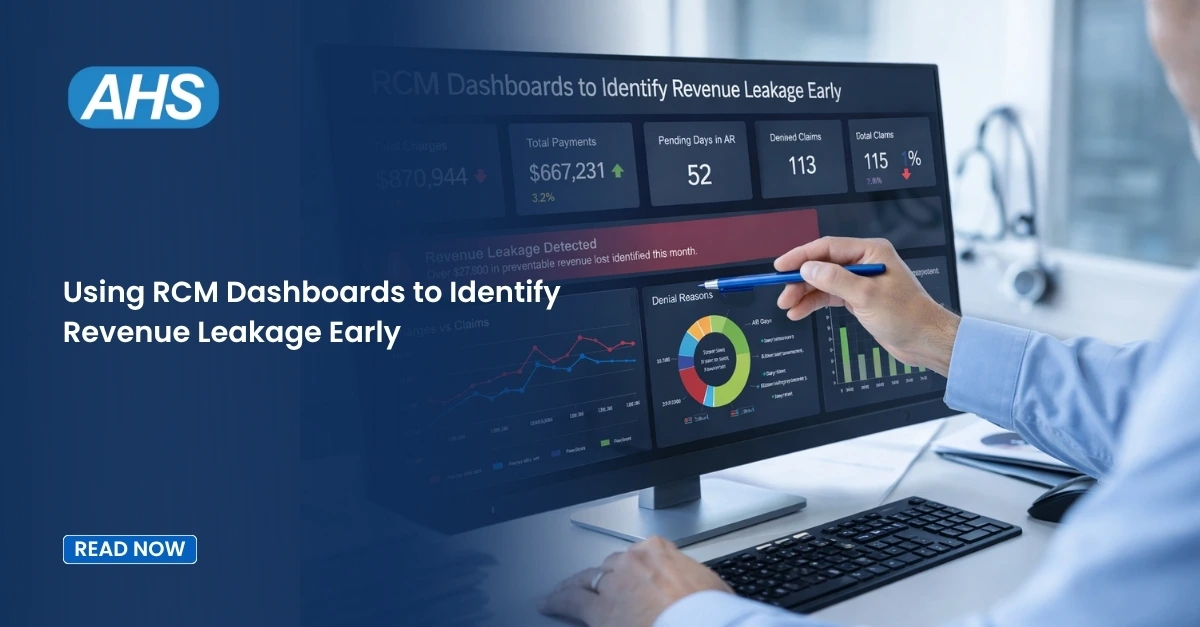
Revenue leakage is the silent killer that eats up 10-18% of practice collections each year. RCM dashboards identify such problems in less than 30 days as opposed to identifying them during the end-of-year audit. This guide unveils the 7 important dashboard metrics practice managers should keep watch on to seal the revenue leaks before they can affect the cash flow.
What is Revenue Leakage?
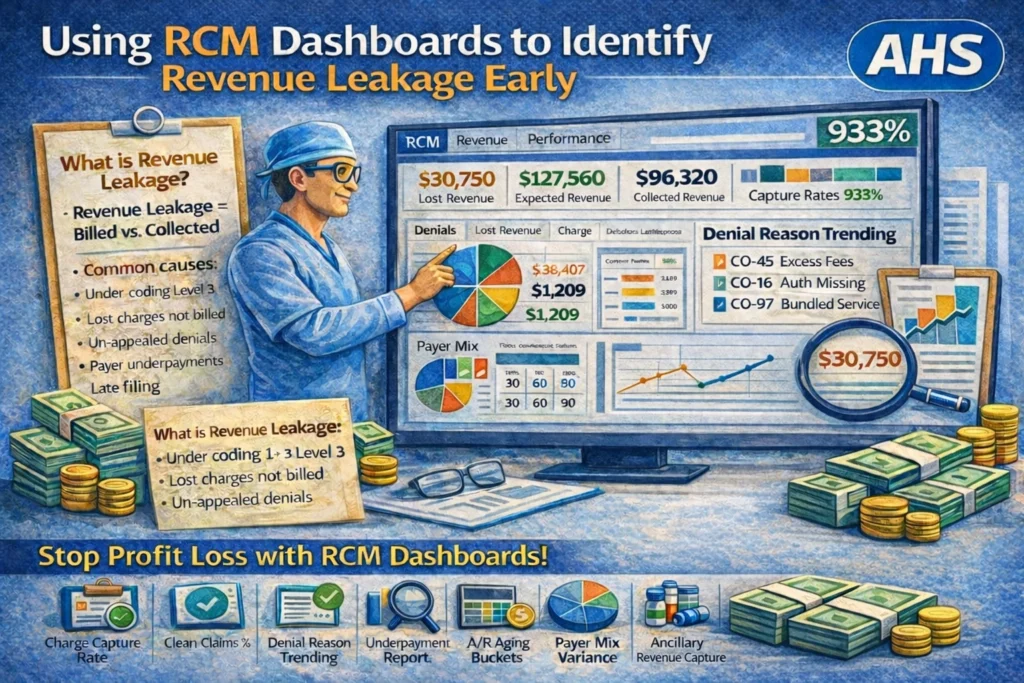
Revenue leakage = difference between billed and collected with contractual adjustments.
Common causes:
- Level 3 under-codified (Level 2 billed as Level 3) services.
- Lost charges (ancillary services not recorded)
- Denials not appealed (technical vs. clinical)
- Underpayments (payer contract discrepancies)
- Late filing (claims older than 90 days)
Industry standard: The leakage should be below 3% of gross charges.

7 Dashboard Metrics That Catch Leakage Early
1. Charge Capture Rate (Daily)
Target: 98%+
Formula: Captured charges ÷ Encounter volume
Red Flag: 95% of missed injections, procedures, or point-of-care testing.
Action: Daily superbill reconciliation.
2. Clean Claims % (Daily)
Target: 95%+
Red Flag**: <90% = coding errors, auth issues
Virginia/Arizona Case Study: Anthem BCBS LCD discrepancies will result in 25% rejections.
3. Denial Reason Trending (Weekly)
Top Leakage Codes:
CO-45: Charge exceeds fee schedule
CO-16: Auth missing
CO-97: Bundled service
Action: The top 3 denial codes receive workflow corrections.
4. Underpayment Report (Monthly)
Formula: Expected reimbursement – Actual payment
Target: <$500/mo per provider
Example: Medicare pays $85, contract says $92 = $7 leakage per claim.
5. A/R Aging Buckets (Weekly)
90+ days >10% total A/R = Leakage alert
120+ days >5% = Write-off risk
Action: First (LIFO) old claims.
6. Payer Mix Variance (Monthly)
Medicare: Expected 95% collection rate
Commercial: Expected 92-97%
Medicaid: Expected 88-92%
Red Flag: Medicare collecting less than 90% is an indicator of underpayments.
7. Ancillary Revenue Capture (Monthly)
Injection revenue: 85%+ capture rate
Point-of-care testing: 90%+ capture
DME/Orthotics: 80%+ capture
Leakage: 50 percent missed injections of Kenalog = loss of 25k a year.
RCM Dashboard Setup Best Practices
1. Epic Caboodle / Athenahealth
Pre-built: Denial trends, A/R aging, clean claims
Custom: Charge capture by ancillary service
Export: Weekly Excel pivot tables
2. Kareo / AdvancedMD
Focus: Underpayment reports, payer variance
Alert: Claims >60 days auto-escalate
Drill-down: Denial reason by CPT code
3. Practice-Fusion / eClinicalWorks
Simple KPI cards: Clean claims, A/R days
Red/Yellow/Green thresholds
Mobile alerts for managers
Regional Dashboard Considerations
Virginia Practices:
Anthem BCBS: Site-of-service differentials
Virginia Medicaid: Dental carve-out tracking
Magellan BH: Auth compliance dashboard
Arizona Practices:
AHCCCS: Prior auth dashboard
Banner Health: Hospital-clinic splits
BCBS AZ: Commercial underpayments
Actionable Leakage Recovery Workflow
Week 1: Dashboard training (30 min)
Week 2: Baseline leakage audit
Week 3: Top 3 fixes implemented
Week 4: 5-8% leakage reduction expected
Monthly Routine:
Monday: Dashboard review (15 min)
Wednesday: Denial root cause fixes
Friday: AR follow-up calls
Results from Dashboard Implementation
Practice Size → Leakage Reduction → Annual Savings
3 Providers → 12% → $187K
15 Providers → 8% → $1.2M
75 Providers → 6% → $4.8M
Key Finding: 85% of leakage is recoverable when caught <90 days via dashboards.
Bottom Line
RCM dashboards transform reactive billing into proactive revenue insight. Practices using these 7 metrics will recover 12-18 % of the lost revenue in 90 days.
Require RCM dashboard? Acuity Health Solutions is offering Virginia, Arizona, and national practice custom KPI dashboards featuring weekly leakage alerts.