

Ophthalmology Medical Billing has a mix of large patient volumes, diagnostic tests that need to be conducted, and encounters that are time-consuming in terms of procedures. Even the smallest gaps in documentation or coding can result in reimbursements, refusal of a claim, or silent underpayment, including those of cataract surgeries and retinal injections, OCT and visual field tests, etc.
An effective processing of the claim begins way before a claim is filed. It starts with proper documentation, coding, and front-end workflow to avoid errors.
The following are some common practice Ophthalmology Billing tips that can be used to enhance reimbursement and reduce administrative tension.
Start With Strong Clinical Documentation
All clean claims require full clinical notes.
Payers are demanding concise instructions on:
- Medical necessity for diagnostic tests
- Laterality (right vs left eye)
- Disease severity and progression
- Treatment plans and follow-up rationale
Generic statements, such as routine follow-up, are not of much use in audits. Rather, there should be notes that provide a reason as to why a test or procedure was done and how the results will affect care.
Clear documentation protects revenue and supports compliance.
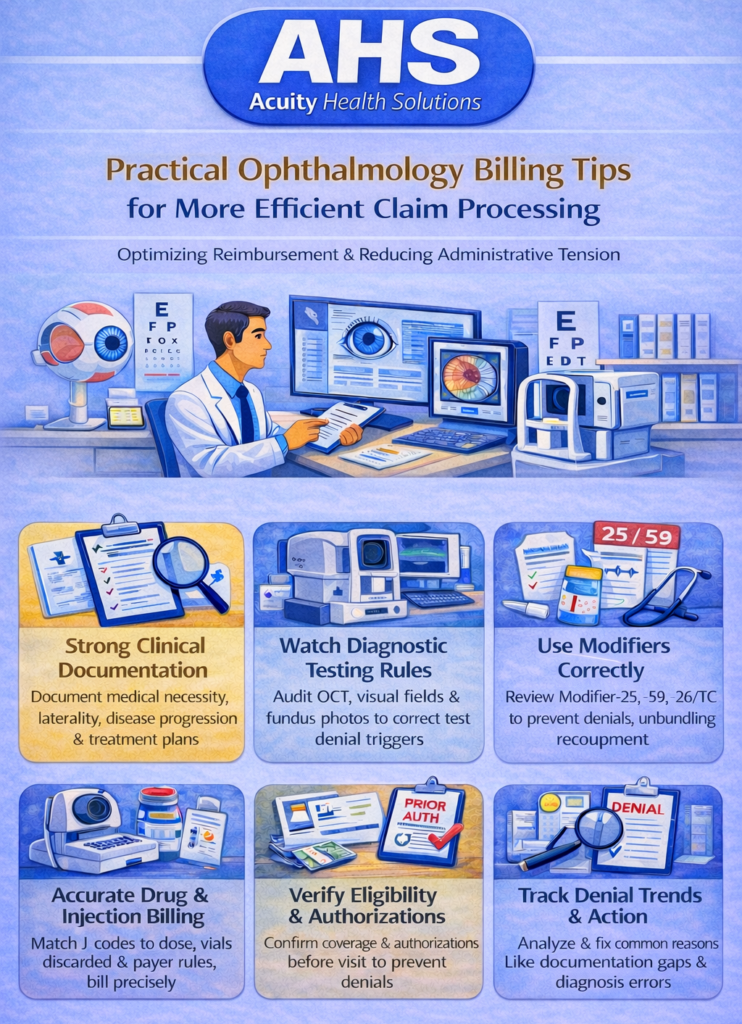
Pay Close Attention to Diagnostic Testing Rules
Payers are very critical of high-volume services like OCT, visual fields, and fundus photography.
Best practices include:
- Associating each test with a particular diagnosis.
- Preventing redundant unclinically justified testing.
- Recording interpretation and clinical decision making.
The most common reason for ophthalmology denials is the absence of test documentation, or rather, the poor quality of test documentation.
Use Modifiers Carefully
Modifier errors have the silent effect of reducing reimbursement more than most of the practices know.
Examples of problem areas are:
- Modifier -25 for same-day E/M with procedures
- Modifier -59 for distinct procedural services
- -26 and -TC for professional vs technical components
Misuse of the Modifiers may result in bundling or reduction of payments without increasing formal denials. Regular audits on the modifier allow the audit to detect lost revenue before time runs out.
Ensure Accurate Drug and Injection Billing
Retinal injections and biologic therapies are a good source of revenue, yet are also subject to audit risk.
Key tips:
- Match J-code units precisely to the administered dose.
- Document discarded medication when applicable.
- Confirm payer-specific billing rules for injected drugs.
- Align clinical notes with billed quantities.
Even unit discrepancies that are small would lead to partial payments or recoupment of payment months later.
Verify Eligibility and Authorizations Before the Visit
Front-end processes have a direct influence on claim success.
Prior to appointments:
- Ensure active insurance cover.
- Determine the need for prior authorization.
- Error-check specialty care referrals.
It is much easier to prevent authorization-related denials than to do so later.
Reconcile Schedules Against Charges
Each encounter with a patient ought to result in an item that will either be billed or documented as no charge.
Simple reconciliation steps include:
- Comparing the schedule for a day versus the charge made.
- Conducting procedure reviews weekly.
- Auditing large volume services.
These checks are used in order to identify missed charges prior to claims being sent out.
Monitor Denial Trends Regularly
Rejections should not be processed individually, but in groups.
This is useful in tracking the causes of denials so that the practices can figure out the systemic problems, such as:
- Documentation gaps
- Modifier misuse
- Diagnosis mismatches
- Authorization failures
First-pass acceptance and cash flow in the long run are enhanced through putting off root causes.
How Acuity Health Solutions Supports Ophthalmology Practices
Acuity Health Solutions assists eye clinics to facilitate claim processing by overseeing workflows of specific specialties, code controls, and proactively preventing any denials. Acuity aims to be decidedly accurate on the front end (matching the documentation, coding, and payer policies) prior to submitting claims as opposed to addressing these issues post-revenue loss.
This system will assist the ophthalmology practices to minimize their denials, accelerate turnaround times, and comply with the goal of providing care to the patients.
Final Thoughts
It is not about more work to achieve better ophthalmology billing, but a more intelligent structure of the systems. Good documentation, correct modifiers, accurate Medical Billing of drugs, and positive front-end controls result in fewer clean claims and quicker reimbursements.
Practices that make investments in such fundamentals experience minimal denials, are able to have a smooth cash flow, and reduce administrative strain- enabling clinicians to concentrate on enjoying quality eye care.