
How Acuity Health Solutions helped a Washington ophthalmology practice uncover revenue-cycle bottlenecks, improve financial visibility, and successfully transition from a decades-old legacy system to a modern EHR platform

A well-established Ophthalmology Practice in Washington had been serving its community for many years. The providers delivered a combination of medical, surgical, and ongoing eye care, supported by an experienced clinical and administrative team.
However, the technology supporting the practice’s billing operations had not evolved alongside the organization.
The practice was still relying on a legacy system originally developed decades ago. Although the platform continued to support basic day-to-day functions, it offered limited reporting capabilities and made it difficult for the providers and leadership team to understand the true performance of their revenue cycle.
The practice was seeing patients and delivering care, but its financial picture remained unclear.
The providers were concerned that the practice was losing revenue, but the existing system could not provide the level of detail needed to confirm where the losses were occurring.
Important questions were difficult to answer:
The problem was not simply that the software was old. The larger issue was that the practice lacked reliable, actionable information.
Without clear reporting, leadership could not easily distinguish between normal payment delays, process inefficiencies, payer-related issues, and potential revenue leakage.
The providers knew something needed to change, but replacing the system immediately without first understanding the existing revenue cycle could have carried those same problems into a new platform.
That is when Acuity Health Solutions was brought in.
Acuity Health Solutions began by working within the practice’s existing legacy environment.
Rather than treating the older system as an immediate obstacle, our team focused first on extracting the information that was available, understanding how the practice’s billing processes currently operated, and identifying the areas requiring the most attention.
Our initial work included:
Reviewing the existing billing and accounts-receivable workflows
Identifying the key revenue-cycle metrics available within the legacy platform
Organizing fragmented billing information into a more usable format
Evaluating claim status, outstanding balances, denials, and follow-up activity
Identifying operational bottlenecks affecting claim progression
Reviewing how billing information moved between the clinical and administrative teams
Establishing clearer reporting and work-tracking processes
Separating system limitations from process-related issues
This gave the practice something it had been missing: a clearer view of what was happening after the patient encounter.
Instead of relying primarily on assumptions or total deposit figures, the providers could begin understanding the underlying activity driving their collections.
Acuity Health Solutions helped the practice focus on the metrics that matter most to revenue-cycle performance.
This included visibility into areas such as:
The objective was not to create reports for the sake of reporting.
Each metric needed to help the practice answer a practical question, assign responsibility, prioritize work, or make a better operational decision.
This allowed the providers to move from:
“We believe revenue may be getting lost.”
to:
“We can now see where claims are delayed, what requires follow-up, and which parts of the process need improvement.”

Once the existing workflows and billing challenges were better understood, Acuity Health Solutions supported the practice through the transition to a modern EHR and practice-management environment.
For an established medical practice, changing systems is rarely a simple software installation.
The transition affects nearly every part of the organization, including:
Patient registration
Insurance information
Scheduling
Clinical documentation
Charge entry
Claim submission
Payment posting
Accounts-receivable follow-up
Patient statements
Reporting
Staff responsibilities
Historical financial data
A rushed transition could have disrupted billing operations, delayed claims, created duplicate work, or caused important balances to be overlooked.
Our team therefore approached the project as both a technology transition and an operational transformation.

One of the most important parts of the project was ensuring that the move to the new EHR did not result in the abandonment of older accounts.
While new patient encounters and claims began moving through the modern platform, outstanding claims and balances still remained in the legacy system.
This effectively created two active revenue-cycle environments:
Acuity Health Solutions helped the practice manage both.
Our team continued reviewing and working legacy accounts while helping establish the processes required for the new system. This reduced the risk of older revenue being forgotten simply because the practice had moved to new technology.
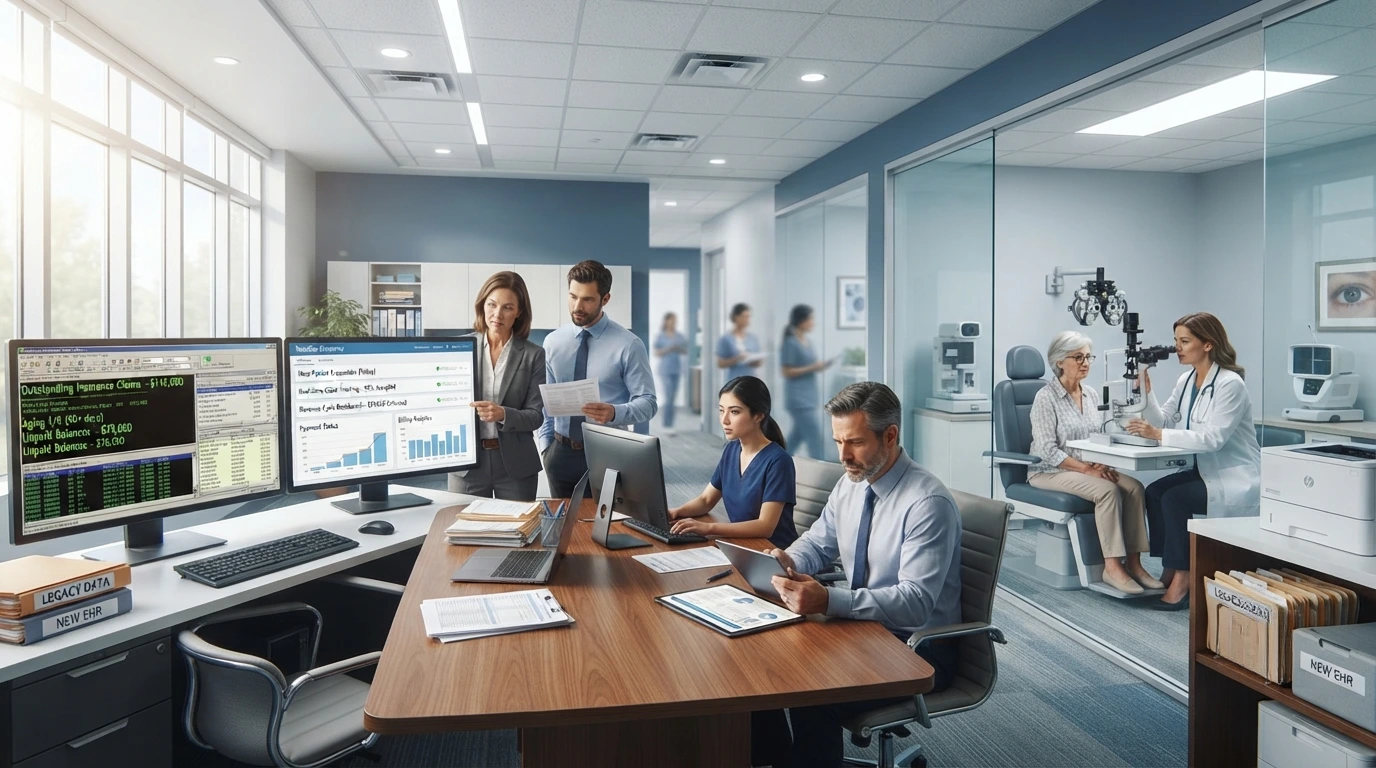
The transition required time, coordination, and continued attention from both the practice and the Acuity Health Solutions team. However, the implementation was completed successfully.
The practice moved away from a decades-old system and established a more modern operational foundation for its clinical and billing activities.
More importantly, the practice gained:
Leadership could better understand outstanding receivables, claim activity, payer issues, and billing priorities.
Work could be organized around defined reports, responsibilities, follow-up categories, and measurable priorities.
The providers no longer had to rely solely on assumptions when evaluating the financial health of the practice.
Claims and balances requiring attention could be identified, assigned, tracked, and followed through to resolution.
The practice moved to a modern EHR while continuing to manage revenue remaining in the legacy system.
The new environment gave the practice a better foundation for reporting, process improvement, staff coordination, and long-term revenue-cycle management.
One of the most important lessons from this engagement was that replacing an outdated system does not automatically resolve the operational problems within a revenue cycle.
A new EHR can provide better tools, but those tools must be supported by:
By first understanding the practice’s existing billing challenges and then supporting the technology transition, Acuity Health Solutions helped ensure the new system became part of the solution rather than simply a newer place for old problems to continue.

Many established practices continue using legacy systems because replacing them feels disruptive, expensive, or operationally risky.
Others have already moved to a newer EHR but still struggle to obtain reliable answers about:
Acuity Health Solutions helps healthcare practices understand what is happening within their revenue cycle, identify the processes limiting collections, and build a practical path toward improvement.
Our support can include:
Your providers should not have to guess whether claims are being paid, balances are being followed, or revenue is being left behind.
Speak with Acuity Health Solutions to discuss your current billing environment, identify potential bottlenecks, and determine the right path forward for your practice.